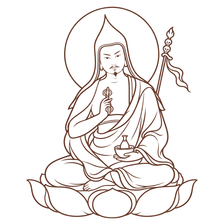
无上瑜伽 Anuttarayoga
(Please Note: This is Chapter Fourteen in the book Journey without Goal.) Body of talk: 36 min. Questions: 19 min. Overall: 56 min. Date: August 14, 1974
(请注意:本讲对应《无目标之旅》第十四章。)讲座正文:36 分钟。提问:19 分钟。总时长:56 分钟。日期:1974 年 8 月 14 日
导言 Introduction
Anuttarayoga is a bridge between the lower tantric yanas (kriya, upa and yoga) and the higher yanas (mahayoga, anu and ati). From the point of view of the lower yanas, anuttara represents the highest achievement. It includes many tantric practices, such as Kalachakra, Chakrasamvara and Guhyasamaja.
无上瑜伽是较低的密续诸乘(事部、行部和瑜伽部)与较高诸乘(玛哈瑜伽、阿努瑜伽和阿底瑜伽)之间的桥梁。从较低诸乘的观点来看,无上瑜伽代表最高成就。它包括许多密续修法,如时轮、胜乐和密集。
基 Ground
We have already talked about the principles of body, speech, and mind. In anuttarayoga, there is a particular emphasis on speech, not as voice or verbal communication alone, but as a principle of energy.
我们已经谈过身、语、意的原则。在无上瑜伽中,特别强调语,它不仅是声音或言语交流,也是能量的原则。
- Through body, speech and mind we relate to the phenomenal world. In tantra, we could almost say that this relationship is not even religious, particularly. Rather, it could be viewed as a nontheistic approach to developing sanity and openness.
- 我们通过身语意与现象世界建立关系。在密续中,我们甚至几乎可以说,这种关系并不特别具有宗教性质。相反,可以将它视为一种发展清明健全与开放的非有神论方式。
- Speech is particularly important in anuttara. Here it is speech-like situations, any interchange that takes place in our world, whether in the realm of hearing, seeing, smelling or other sensory aspects of the body.
- 语在无上瑜伽中尤为重要。这里指的是类似言语的情境,即发生在我们世界中的任何交流,无论在听觉、视觉、嗅觉,还是身体的其他感官方面。
- Speech is a link between our body and us and between our mind and us. Speech brings mind to the cognitive level and body to the energetic level.
- 语是我们与自身身体之间,以及我们与自身心意之间的纽带。语将心意带到认知的层面,将身体带到能量的层面。
- Speechlike interchanges take place constantly in our life. They are an expression of energy. This is not a crude expression of energy, like a gunfight taking place in a bar in the old West. Rather, the energy we are speaking of here is self-existing energy that takes place constantly: The energy of aggression, of passion, of depression, excitement, uncertainty, etc.
- 类似言语的交流不断发生在我们的生活中。它们是能量的表达。这并非粗糙的能量表达,不像旧时美国西部酒吧里发生的一场枪战。相反,我们在这里谈的是不断发生的、本自存在的能量:嗔怒、贪欲、沮丧、兴奋、不确定等等的能量。
- Here, we will discuss this view of energy as presented in the Kalachakra tantra.
- 在这里,我们将讨论《时轮密续》所呈现的这种能量观。
道 Path
Nadi, prana and bindu are the three types of energy that we are discussing. They are a description of how energy works in anuttara yogayana.
脉、气和明点,是我们正在讨论的三种能量。它们描述了能量在无上瑜伽乘中如何运作。
- Nadi: Is like a channel. Energy needs a channel, a way to journey. Nadi is this specialized path. It is like a railroad track, in that it provides a path or pattern that our energy follows. The phenomenal world has already created these pathways or channels for us. We don’t have to set the system up.
- 脉:像一条通道。能量需要通道,需要一条行进的道路。脉就是这条专门的道路。它像铁轨,为能量提供一条可循的路径或模式。现象世界已经为我们创造了这些道路或通道。我们不必自己建立这套系统。
- Prana: The metaphor for prana is a horse looking for a rider. The metaphor of the horse has to do with conviction rather than speed. The pathways of nadi are already set up for us. Prana is the horse that rides on these self-existing tracks in the world.
- 气:气的比喻是一匹寻找骑手的马。以马为喻,关乎的是确信,而非速度。脉的道路已经为我们铺设好了。气就是在世间这些本自存在的轨道上行进的马。
- Bindu: Bindu is the rider of the horse of prana. It is a particular type of consciousness. We have to distinguish bindu from the more mechanical aspect of mind, sem (Tibetan). Sem responds to reference points, while bindu is more the sense of consciousness taking a journey. It is more of an awake quality.
- 明点:明点是骑在气这匹马上的骑手。它是一种特定的意识。我们必须将明点与心较为机械的一面,即 sem(藏语),区分开来。sem 对参照点作出反应,而明点更像是意识在旅行的感觉。它更具觉醒的特质。
- An analogy for all three energies is that bindu is a radar system mounted to the tracks, or nadi, through a wheel, which is prana. Bindu guides or controls the journey. The whole process is based on energy.
- 对这三种能量的一个比喻是:明点是一套雷达系统,通过作为气的车轮,安装在作为脉的轨道上。明点引导或控制这段旅程。整个过程以能量为基础。
果 Fruition
At the highest level of anuttarayoga, we transcend this way of seeing the journey. Greater openness and expansion begins to occur. We see the journey more like the unfolding of a flower. The monogram EVAM symbolizes this greater openness.
在无上瑜伽的最高层次,我们超越了这种看待旅程的方式。更大的开放和扩展开始发生。我们更多地将旅程看成花朵的绽放。组合字 EVAM 象征着这种更大的开放。
- E is the level of basic accommodation or openness. In this space, the existence of buddhas and sentient beings is saying the same thing. At this level, sorting out buddhas and confused beings is irrelevant. E comes straight from your heart. You breathe out: ehhh. It is the sound of opening up without particular definition or reference points.
- E 是基本的容纳或开放这一层面。在这个空间中,诸佛与众生的存在诉说着同一件事。在这一层面,区分诸佛与迷惑的众生毫无意义。E 直接发自你的心。你呼气:ehhh。它是开放的声音,没有特定的定义或参照点。
- Having that enormous space, then you have VAM. E is the mother and VAM is the son. The two are not in conflict, however. VAM principle is the energy that exists within the E of nonduality. It represents discipline within the spaciousness of E. It is one-pointedness.
- 有了这巨大的空间,便有了 VAM。E 是母亲,VAM 是儿子。然而,两者并不冲突。VAM 的原则,是存在于不二之 E 内的能量。它代表 E 的宽广之中的自律。它是专一。
- EVAM is a central monogram of the Kalachakra tantra. It is also the personal seal of the Trungpas.
- EVAM 是《时轮密续》的一个核心组合字。它也是历代创巴的个人印章。
- In anuttarayoga, we can use any form of confusion, doubt or hallucination that we experience in ordinary everyday life. First there is an experience, and then there is the echo of that experience, where we question it or have second thoughts. VAM is the first sharp vision and E is the shadow or echo around that.
- 在无上瑜伽中,我们可以运用在平凡日常生活中体验到的任何形式的迷惑、怀疑或幻觉。先有一个体验,随后是这个体验的回响,我们在其中质疑它,或重新思量。VAM 是最初敏锐的看见,E 则是环绕它的阴影或回响。
- We have a sharp vision first and then a shadow around it. So we are seeing EVAM constantly. This is the basic approach of anuttara: allowing doubt and including it in our journey.
- 我们先有敏锐的看见,随后其周围出现阴影。因此,我们不断地看见 EVAM。这就是无上瑜伽的基本方式:允许怀疑,并将它纳入我们的旅程。
听众提出的问题 Questions asked by the audience
1) Do the tantric yogas involve movement and postures as is taught in Hindu yoga?
1) 密续瑜伽是否包含印度教瑜伽所教的动作和姿势?
2) Your discussion of emotions in tantra is quite different from an ordinary view. Can you say more?
2) 您对密续中情绪的讨论,与通常的看法很不一样。能否多讲一些?
3) Are preconceived ways of relating to life nadi?
3) 以预先设想的方式与生活相处,就是脉吗?
4) In anuttara, one sees doubt and confusion as helpful. Is this view appropriate for a new practitioner?
4) 在无上瑜伽中,怀疑和迷惑被视为有帮助的。这种看法适合初学者吗?
5) I’ve heard about vajra hell and it scares me. How can I avoid it?
5) 我听说过金刚地狱,这让我害怕。我该如何避免它?
6) How do nadi, prana and bindu relate to tantric deities?
6) 脉、气和明点与密续本尊有何关系?
7) How do these three energies relate to the gunas from Hindu tantra?
7) 这三种能量与印度教密续中的三德有何关系?
8) Where does anuttara fit into the six yanas?
8) 无上瑜伽在六乘中处于什么位置?
9) In the analogy of track, wheel and radar system, what is the function of the radar?
9) 在轨道、车轮和雷达系统的比喻中,雷达的作用是什么?