The Explicit and Hidden Aspects of Tāra:
度母的显义与隐义:
Commentary on the Twenty-One Praises to Tāra
《二十一度母赞》释
By Jetsun Tāranātha
至尊多罗那他 著
Translated and edited by Adele Tomlin
Adele Tomlin 翻译、编校
THE EXPLICIT AND HIDDEN ASPECTS OF TĀRA:
度母的显义与隐义:
Commentary on the Twenty-One Praises to Tāra
《二十一度母赞》释
By Jetsun Tāranātha
至尊多罗那他 著
Author: Jetsun Tāranātha
作者:至尊多罗那他
Translator and Editor: Adele Tomlin
译者兼编者:Adele Tomlin
TO BE READ ONLY BY THOSE WITH TĀRA AND KĀLACAKRA EMPOWERMENTS
仅供已接受度母及时轮灌顶者阅读
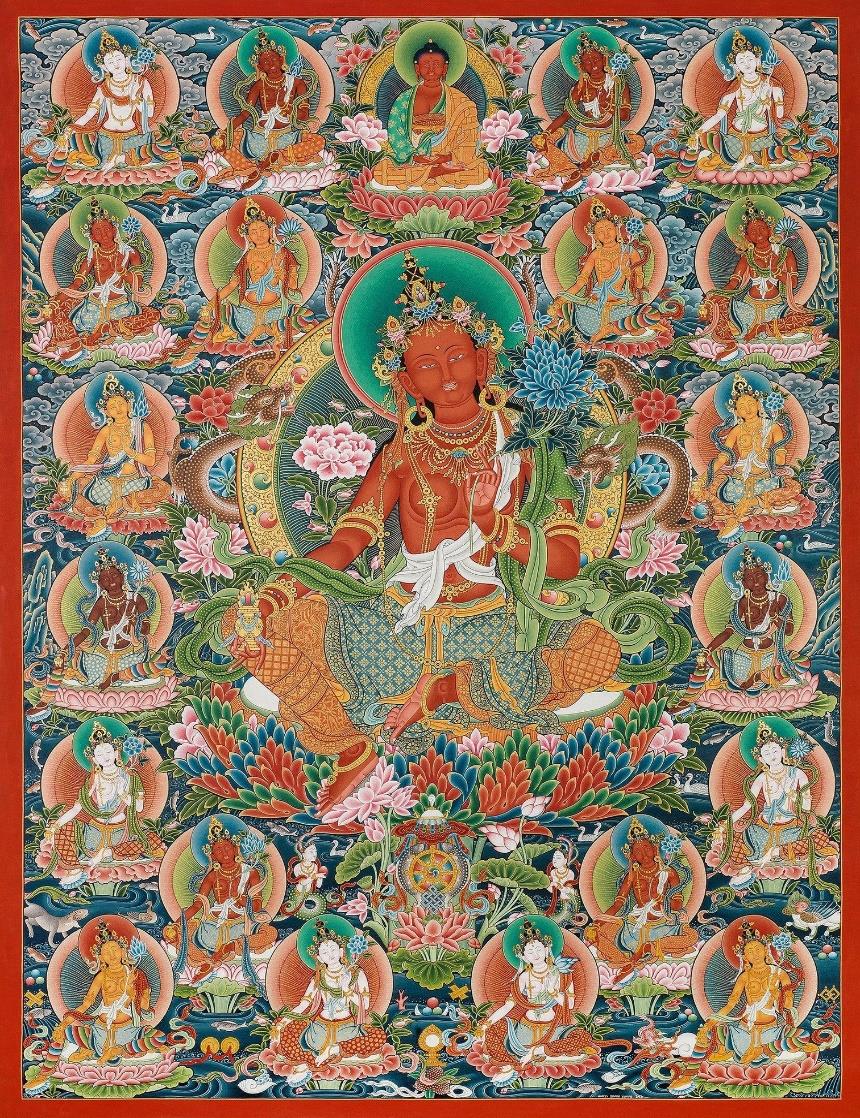
First Edition, 2020. Cover Image by Mukti Singh Thapa (Mahakala Fine Arts.com)
第一版,2020年。封面图像由 Mukti Singh Thapa 绘制(Mahakala Fine Arts.com)。
Publishing and Content Copyright: Adele Tomlin/Dakini Publications, 2020. This publication is meant for personal use only and is not to be re-published, copied, shared or used publicly without express permission from the publisher and translator.
出版与内容版权:Adele Tomlin/Dakini Publications,2020年。本出版物仅供个人使用;未经出版者及译者明确许可,不得再版、复制、分享或公开使用。
译者导言 Translator’s Introduction
This is the first published English translation of the Commentary on the Praises to the Twenty-One Tāras, composed by Jonang, and Shangpa Kagyu, master Tāranātha (1575-1634)1. The text gives a verse- by-verse explanation of both the explicit (or literal) meaning of the words of the commonly-recited Praises to the Twenty-One Tāras, as well as their hidden (or secret) meaning.
这是觉囊派及香巴噶举派大师多罗那他(1575—1634)所著《二十一度母赞释》的首部已出版英译本1。本书逐偈解释通常诵持的《二十一度母赞》词句的显义(或字面义),以及隐义(或秘密义)。
《二十一度母赞》 The Praises to the Twenty-One Tāras
The tantra known as the Praises to the Twenty-One Tāras is said to be spoken by the Buddha Samantabhadra, out of which arose the system of practice with twenty-one Tāra emanations - one for each verse of praise. Each form of Tāra has a specific colour and accomplishes a specific activity. There are said to be at least four ‘twenty-one Tāra’ traditions, those of Sūrya-Gupta (7th/8th cent.), Atīśa Dipaṃkara (982-1054), Longchen Rabjampa (1308-1363), and Terchen Chokgyur Lingpa (1829-1870). The latter three traditions are very similar in that the individual Tārās are described as varying only slightly in body colour and the emblems shown on the lotus flowers they hold. The two most well-known are the twenty-one Tāras according to the Atīśa tradition, and the earlier, more complex, twenty-one Tāras according to the great Mahasiddha Sūrya-Gupta 2. In the Atīśa system all the Tāras have the same basic appearance and only differ in the colour of the body. Green is considered the primary colour of Tāra based on other teaching lineages describing Tāra in solitary form or with the accompanying deities Marichi and Ekajati. However, green Tāra is not included in the enumeration of the Twenty-one Tāras of Atīśa. There are four red Tāras, six white, three yellow, four orange, two maroon (red-black) and two black Tāras for a total of twenty-one. Some of the Tāras are described as being slightly fierce, meaning they may have an open mouth with slightly enlarged canine teeth and furrowed brow above the eyes. The Mahasiddha Sūrya-Gupta lineage of the twenty-one Tāras is quite different from the Atīśa lineage in that each of the twenty-one Tāras is very distinctive in appearance and attributes and each Tāra has her own sadhana3. Tāranātha does not specify which tradition and visualisations he follows in this commentary. However, in his other commentary on the twenty-one Tāras (see below) he states that he is teaching the Atīśa tradition. Instruction on how to understand this text in greater detail should be sought from a qualified lama4.
称为《二十一度母赞》的密续,据说是普贤佛所说,由此产生了二十一尊度母化现的修法体系,每一赞偈对应一尊。每尊度母各有特定身色,并成办特定事业。据说至少有四种“二十一度母”传承,分别为日藏(7或8世纪)、阿底峡·燃灯(982—1054)、龙钦绕降(1308—1363)及大伏藏师秋吉林巴(1829—1870)的传承。后三种传承非常相似,其中各尊度母仅在身色及所持莲花上的标帜方面略有不同。最为人熟知的两种,是阿底峡传承的二十一度母,以及年代更早、形相更复杂的大成就者日藏传承的二十一度母2。在阿底峡体系中,所有度母的基本形相相同,仅身色有别。其他教授传承将度母描述为独尊,或与随侍的摩利支天和一髻佛母同现;依据这些传承,绿色被视为度母的主要身色。然而,阿底峡二十一度母的名目中并不包括绿度母。其中有四尊红度母、六尊白度母、三尊黄度母、四尊橙色度母、两尊栗色(红黑色)度母及两尊黑度母,共二十一尊。有些度母被描述为略带忿怒,也就是说,她们可能张着嘴,犬齿稍大,双眼上方的眉头蹙起。大成就者日藏的二十一度母传承与阿底峡传承颇为不同:其中每一尊度母的形相与特征都十分独特,并且各有自己的修法3。多罗那他在本释中并未指明所遵循的是哪一种传承与观想。不过,他在另一部二十一度母释论(见下文)中表示,所教授的是阿底峡传承。若要更深入地理解本文,应向具格上师求取教授4。
多罗那他与二十一度母 Tāranātha and the twenty-one Tāras
Tāranātha was an expert scholar and practitioner on Tāra. He wrote several sadhanas and instruction texts about Tāra, and a historical text about the origin and history of the Tāra tantras, which has been translated and published in English by David Templeman5. In a recent article by Templeman, Tāranātha describes what happened when he met his Indian master teacher, Buddhaguptanātha6:
The ascetic told the young student of his own trans-oceanic travels to Potalaka, the abode of Avalokiteśvara, which was also believed to be the abode of the form of Tārā known as Bhṛkuṭī as well as being the actual residence of Tārā. The young Tāranātha requested Buddhaguptanātha for the yoga empowerments for Tārā, the root instructions for her practice as well as for the requisite blessings to permit him to commence them. He then had certain visionary dreams of Tārā and other deities who predicted that if he were to supplicate Avalokiteśvara until his twentieth year he would become a master of the caryā practices of Avadhūtipa and would as a result spread the Buddhist doctrine in various nearby lands, especially in Garzha (Gar zha) in the region of Zangskar (Tzangs dkar). Almost drily, Tāranātha observes that despite this dream prophecy of Tārā he never really put the necessary requirements into practice and therefore did not fulfil the prophecy.
这位苦行者向年轻的学生讲述了自己渡海前往补怛洛迦的旅程。补怛洛迦是观世音的住处,也被认为是名为颦眉母的度母化身之住处,同时也是度母实际居住之地。年轻的多罗那他向 佛陀笈多那他 请求度母瑜伽灌顶、修持度母的根本教授,以及得以开始这些修持所需的加持。随后,他在若干梦境中见到度母及其他本尊。祂们授记说,若他持续祈请观世音,直至二十岁,就会精通 Avadhūtipa 的行部修法,并因此在附近各地弘扬佛法,尤其是在桑斯噶尔(Tzangs dkar)地区的 Garzha(Gar zha)。多罗那他几乎不带感情色彩地指出,尽管梦中得到度母的这一授记,他实际上从未付诸实践、完成必要的要求,因此也未能实现这一授记。
本释 The commentary
There are three extant editions of this Tibetan commentary available online at TBRC. The main one I have used is in the Collected Works of Tāranātha, published in Beijing9. It is also contained in the other major editions of Tāranātha’s Collected Works, under a different Tibetan title10. As far as I can see, there are no major differences between the texts, although I have not done a critical edition.
There is another Tāra commentary written by Tāranātha, on the definitive aspects of Tāra The Ṭīkā Commentary on the Definitive Characteristics of Noble Tāra, which is found in the Beijing and Dzamthang editions of his Collected Works11. In the colophon of this work, it states that it was composed by Tāranatha when he was thirty years old. This second commentary is very similar to the main commentary translated here, however, as there are slight differences or additional explanations, I have included them as annotations where relevant. In this second text, for example, Tāranātha refers to the ‘hidden’ meaning as ‘definitive’.
多罗那他另著有一部阐述度母了义的度母释论,即《圣度母了义特征蒂迦释》,收于其文集的北京版与壤塘版11。该作跋文说,多罗那他撰写此书时年三十。这第二部释论与此处所译的主要释论十分相近;不过,由于其中有些细微差异或补充解释,我已在相关之处将其列入注释。例如,在这第二部文本中,多罗那他将“隐义”称为“了义”。
The main section of the commentary (that is translated here) consists of a verse-by-verse explanation of the twenty-one Tāras, in terms of the explicit and hidden meaning. The text does not state when, or where, Tāranātha wrote the text and it is not clearly mentioned in his biographical material, according to scholar, David Templeman.
这部释论的主体部分(即此处所译的部分),是从显义与隐义两个方面逐偈解释二十一度母。文本没有交代多罗那他写作的时间、地点;据学者 David Templeman 所说,其传记资料中也未明确提及。
时轮六支金刚瑜伽及其与度母的联系 The Kālacakra six vajra-yogas and their connection to Tāra
In this commentary, within the explanations of the hidden meaning, Tāranātha refers to how the Tāra connects to the six vajra-yogas of Kālacakra12. However, as he does not give the actual pith instructions on them, it would not be inappropriate for people to read it. Nonetheless, it is highly recommended to have the Tāra and/or Kālacakra empowerment, transmission and instruction before reading this text.
在本释的隐义解释中,多罗那他提及度母如何与时轮六支金刚瑜伽相联系12。不过,由于他没有给出这些瑜伽的实际口诀,人们阅读本文并无不妥。尽管如此,仍极力建议在阅读本文之前,先获得度母及/或时轮的灌顶、传承与教授。
In the Kālacakra tradition, the completion stage consists of six vajra yogas. These practises involve the manipulation and control of the channels, winds and essential drops. By doing this, a practitioner can attain the fully enlightened vajra-body state of Kālacakra, or here Tāra, in one lifetime13. Deities are sambhogakhāya Buddhas and so, even though on the relative level they appear different with differing qualities and aspects, on the ultimate level they are inseparable from and are the embodiments of the ultimate Buddha, the Tathāgatagarbha. Therefore, in that respect, all deity practices are leading to the same result.
在时轮传承中,圆满次第由六支金刚瑜伽组成。这些修持涉及对脉、风及明点的调运与控制。借此,修行者能够在一生之中成就时轮——在此则为度母——圆满觉悟的金刚身境界13。本尊是报身佛,因此,虽然在世俗层面祂们显现为不同形相,具备不同功德与面貌,但在究竟层面,祂们与究竟佛——如来藏——不可分离,且正是其体现。因此,从这一点而言,一切本尊修法都导向相同的果。
When Tāranātha specifically refers to one of the vajra- yogas, I have included annotated references of some of the descriptions given by Tāranātha in his major root text on the Kālacakra preliminaries and six vajra-yogas, Meaningful to See14 and some of Jamgon Kongtrul the First (a devoted follower of Jonang Kālacakra and Tāranātha), in his Treasury of Instructions: Book Eight, Part Four: Esoteric Instructions.15
For Tāranātha, the Kālacakra six vajra-yogas are the pinnacle of all the tantras; all other advanced practices, whatever name they go by, include them. As he states at the beginning of his instructions on the six vajra-yogas in Meaningful to See16:
对多罗那他而言,时轮六支金刚瑜伽是一切密续之巅;其他所有高阶修法,无论以何种名称流传,都包含这六支。正如他在《见即有益》的六支金刚瑜伽教授开头所说16:
It is stated in the (Kālacakra) Mulatantra and in the Guhyasamaja UtTāratantra: "individual sense withdrawal, mental focus, wind control, retention, recollection and samadhi are held to be the six-branch yogas." Also, in the Cakrasamvaramulatantra, it is said: "Realization is achieved through mantra repetition, wind-control and bliss." Also, in Hevajra: "Contemplating the six branches, the yogin..." There are many other such comments. In brief, the six branches are: individual sense withdrawal, mental focus, wind control, retention, recollection and samadhi.
《时轮根本续》与《密集后续》中说:“收摄、禅定、调息、执持、随念与三摩地,被认为是六支瑜伽。”又如《胜乐根本续》所说:“由诵咒、调息及乐而获得证悟。”《喜金刚》中又说:“观修六支,瑜伽士……”类似说法还有许多。简言之,六支是:收摄、禅定、调息、执持、随念与三摩地。
From the point of view of the yoga of the four vajras, individual sense withdrawal and mental focus are the yoga of body-vajra, wind control and retention are the yoga of speech-vajra, recollection is the yoga of mind-vajra, and, samadhi is the yoga of awareness-vajra. From the point of view of the four-fold approach-accomplishment, individual sense withdrawal and mental focus are ‘approach’ (bsnyen pa), wind control and retention are ‘near accomplishment’ (nyer sgrub, also called 'close approach'), recollection is ‘accomplishment’, and, samadhi is ‘great accomplishment’.
从四金刚瑜伽的角度而言,收摄与禅定是身金刚瑜伽,调息与执持是语金刚瑜伽,随念是意金刚瑜伽,三摩地则是智金刚瑜伽。从四种念修的角度而言,收摄与禅定是“念诵”(bsnyen pa),调息与执持是“近成就”(nyer sgrub,也称“近念诵”),随念是“成就”,三摩地则是“大成就”。
Here in this text too, according to Tāranātha, the practice of the hidden (or ultimate) aspects of the twenty-one Tāras, is a practice on the six vajra-yogas.
在本文中也是如此:依多罗那他所说,二十一度母隐义(或究竟义)的修持,就是六支金刚瑜伽的修持。
I received the direct oral transmission and instruction on the text from Jonang lama, Chokyi Nangwa Rinpoche in 2017. However, due to various obstacles and lack of harmonious and supportive conditions, the translation was unable to be completed until 2020. Thanks also to my sponsors, friends and supporters, in particular, Gonpo Jack, Louise, and the Khyentse Foundation. I apologise for any errors and dedicate any merit so that we may one day see all sentient beings as precious and worthy of our love and compassion, like our only child and thus attain the fully awakened state. Eternal thanks always to precious root lama, HH 17th Karmapa, Orgyen Trinley Dorje, for bringing me onto the Dharma path in 2005 and may all the obstacles facing him and Karma Kagyu be swiftly eliminated.
2017年,我从觉囊上师 Chokyi Nangwa 仁波切处,直接获得本文的口传与教授。然而,由于种种障碍,又缺乏和谐、支持的条件,翻译直到2020年才得以完成。也感谢我的施主、朋友与支持者,尤其是 Gonpo Jack、Louise 以及钦哲基金会。对于任何错谬,我谨致歉意;并将一切功德回向,愿我们有朝一日能视一切有情如自己的独生子女一般珍贵,值得我们给予爱与慈悲,从而成就圆满觉悟的境界。永远感恩珍贵的根本上师,第十七世噶玛巴尊者邬金钦列多杰,他于2005年引领我踏上佛法之道;愿他与噶玛噶举所面临的一切障碍迅速消除。
May it be of benefit!
愿有所利益!
本篇原注
1
Although this text, and some of the teachings contained within it, are indirectly referred to in DONGYAL and SHERAB (2007), they do not provide a reference for, or direct translation of, the text nor its connection to the six Vajra-yogas. They also do not appear to have had the lineage transmission of the text from a qualified Jonang or Kalacakra lineage master.
虽然DONGYAL与SHERAB(2007)间接提到本文及其中部分教法,但并未给出本文的出处或直接译文,也未说明它与六支金刚瑜伽的关联。他们似乎也未曾从具资格的觉囊或时轮传承上师处,获得本文的传承。
2
Thomas Roth says (2009): “According to Tāranātha, Sūrya-Gupta was born in present day Kashmir. A Mahāsiddha who practiced and accomplished Tārā for seven consecutive lifetimes, he was a contemporary of such masters as Śantideva, Candrakīrti, and Candragomin, another important master in the various transmission lineages of the Tārā tantras and practices.” https://jonangfoundation.org/blog/21-t%C4%81r%C4%81s-s%C5%ABrya-gupta
Thomas Roth说(2009):“据多罗那他所述,日藏出生于今克什米尔。他是一位连续七世修持并成就度母的大成就者,与寂天、月称及月官等大师同时代;月官也是度母密续与修法诸传承中的另一位重要大师。”https://jonangfoundation.org/blog/21-t%C4%81r%C4%81s-s%C5%ABrya-gupta
3
For an extensive description of the twenty-one Taras according to the Sūrya-Gupta lineage, see the post: ‘The 21 Tārās of Sūrya-Gupta’ by Thomas Roth (2009), see citation above.
关于日藏传承二十一度母的详细描述,见Thomas Roth(2009)的文章〈日藏的二十一度母〉,出处见上。
4
Martin Willson in his book, In Praise of Tārā (1992), traces many different lineages of Tārā Tantras, Tārā scriptures used as Tantric sadhanas. Willson's work also contains charts which show origins of her tantras in various lineages. Tārā as a tantric practice quickly spread from around the 7th century CE onwards.
Martin Willson在《礼赞度母》(1992)中,追溯了度母密续的许多不同传承,以及用作密续修法的度母经文。Willson的著作也附有图表,显示她的密续在各传承中的起源。作为一种密续修持,度母修法约自公元7世纪起迅速传播。
5
Origin of the Tāra Tantra by Jetsun Tāranātha, tr. David Templeman (LTWA, 2007).
至尊多罗那他著《度母密续的起源》,David Templeman译,LTWA,2007年。
6
Buddhaguptanātha, an Indian tantric master, (16th century) was one of the main teachers of Tāranātha. His life was recorded in extensive detail by Tāranātha who wrote his biography around the year 1601. Tāranātha's work is almost entirely devoted to his journeys across South and Southeast Asia and the many miraculous events that he experienced. Tāranātha presents the narrative as a faithful account of the events as told him by Buddhagupta himself. For more on his life, see TEMPLEMAN (1997) and the Treasury of Lives biography.
印度密续大师佛陀笈多那他(Buddhaguptanātha,16世纪)是多罗那他的主要上师之一。多罗那他约于1601年撰写其传记,极为详尽地记述了他的一生。这部著作几乎全部讲述他游历南亚、东南亚的经历,以及其间遇到的诸多神奇事件。多罗那他将这一叙述呈现为对佛陀笈多亲口讲述之事的忠实记录。关于他的生平,详见TEMPLEMAN(1997)及Treasury of Lives中的传记。
7
Yi dam rgya mtsho’i sgrub thabs rin chen ‘byung gnas often called Rinjung for short.
Yi dam rgya mtsho’i sgrub thabs rin chen ‘byung gnas,常简称Rinjung。
8
For an English translation of these different descriptions, see the post by Thomas Roth (2009) at https://jonangfoundation.org/blog/tāranātha’s-descriptions-tārā
这些不同描述的英译,见Thomas Roth(2009)的文章:https://jonangfoundation.org/blog/tāranātha’s-descriptions-tārā
9
See: Collected Works by Tāranātha, Peking edition,)Jo nang rje btsun tA ra nA tha'i gsung 'bum, dpe bsdur ma/), vol. 24, pp.71-94, 2008. TBRC W1PD45495.
见《多罗那他文集》北京版,Jo nang rje btsun tA ra nA tha'i gsung 'bum, dpe bsdur ma/,第24卷,第71—94页,2008年。TBRC W1PD45495。
10
The same text, which is titled, Explanation of Tāra (sgrol ma'i 'grel pa/) is found in the Dzamthang edition, Vol. 12, pp. 573-603; and in the Tagten Phunthsog Ling edition (rtag brtan phun tshongs gling gi par ma/), Vol. 12, pp.565-594.
同一文本题作《度母释》(sgrol ma'i 'grel pa/),见壤塘版第12卷,第573—603页;另见达丹彭措林版(rtag brtan phun tshongs gling gi par ma/)第12卷,第565—594页。
11
'phags ma'i sgrol ma'i mtshan nges pa'i TIk+ka 'grel pa rnams kyi lugs su sbyar ba, in the Peking edition, Vol. 42, pp. 39-53, TBRC W1PD45495 and Dzamthang edition, pp.545-563, TBRC W22276. In the Introduction to this text, Tāranātha states that:
'phags ma'i sgrol ma'i mtshan nges pa'i TIk+ka 'grel pa rnams kyi lugs su sbyar ba,见北京版第42卷,第39—53页,TBRC W1PD45495;以及壤塘版第545—563页,TBRC W22276。在本文导言中,多罗那他说:
Here the definitive characteristics of the renowned essence of the source of the Tāra tantras, is that of the tradition of the Twenty-One Tāras of great master, Dipamkara Shri Jnana (Atisha). Atisha himself, made a concise summary of his extensive explanations of the tantra. This is that together extended with some other explanations taught by lamas. In relation to that, there are three teachings: the explanation of the meaning of the Praises to the Twenty-One Tāras, the application [training] of the definitive characteristics and the number of characteristics. From among those three, first, if one speaks of a word by word commentary, since there are many, I will roll it up into the essence.
这里,作为度母诸续之源而著称的精髓,其了义特征属于大阿阇黎燃灯吉祥智(阿底峡)的二十一度母传承。阿底峡本人将他对该续的广大解释作了简要归纳。此处即在此基础上,结合上师所授的一些其他解释加以扩充。与此相关,有三项教说:二十一度母赞的释义、了义特征的运用[训练]以及特征的数目。这三者之中,首先,若逐字作注,由于内容繁多,我将摄为精要。
I have only translated the first of these three: the explanation of the word for word meaning, for the purposes of this text.
为了本文,我只翻译了这三项中的第一项,即逐字释义。
12
Six vajra-yogas (ṣaḍañga-yoga, sbyor drug). These are the completion stage practices according to the Kālacakra system. The six yogas are:
六支金刚瑜伽(ṣaḍañga-yoga,sbyor drug),是时轮体系的圆满次第修法。六支瑜伽为:
1. so sor sdud pa – individual sense withdrawal (pratyāhara)
1. so sor sdud pa——收摄(pratyāhara);
2. bsam gtan - mental focus (dhyāna)
2. bsam gtan——禅定(dhyāna);
3. srog rtsol - wind control (prāṇāyāma)
3. srog rtsol——调息(prāṇāyāma);
4. 'dzin pa – retention (dharāṇā)
4. 'dzin pa——执持(dharāṇā);
5. rjes dran – recollection ( anusmṛiti)
5. rjes dran——随念(anusmṛiti);
6. ting nge ‘dzin – samādhi (samādhi)
6. ting nge ‘dzin——三摩地(samādhi)。
13
For more on this see DHARGYEY (1998) and TOMLIN (2019a and b). The recently passed scholar-translator, Edward Henning, also gave some detailed descriptions of the six vajra-yogas on his website, www.kalacakra.org and in his article ‘The Six Vajra Yogas’ (see HENNING 2009).
更多内容见DHARGYEY(1998)及TOMLIN(2019a、b)。新近去世的学者兼译者Edward Henning,也在其网站www.kalacakra.org及〈六支金刚瑜伽〉一文中,对六支金刚瑜伽作过一些详细描述(见HENNING 2009)。
14
Meaningful to See (mThong ba don ldan) is an important text by Tāranātha, and is still used by the Jonang and other traditions when teaching the Kālacakra six vajra-yogas. Unpublished translations of this short, root text have been completed by Cyrus Stearns and Edward Henning. I have now also translated this text and the much larger supplementary commentary to it, A Hundred Blazing Lights. Both texts will be published together in the near future. The edition I have used here is the Peking edition (2008), see Zab lam rdo rje'i rnal 'byor gyi khrid yig mthong ba don ldan/ in gsung 'bum/_tA ra nA tha/ (dpe bsdur ma/), Volume 7, pp. 33 – 138, TBRC W1PD45495.
《见即有益》(mThong ba don ldan)是多罗那他的一部重要著作,觉囊及其他传承教授时轮六支金刚瑜伽时,至今仍使用它。Cyrus Stearns与Edward Henning已完成这部简短根本文本的译文,但尚未出版。我现在也已译出本文及其篇幅大得多的补释《百道炽光》。两部文本将在不久的将来合并出版。我在这里使用的是北京版(2008);见gsung 'bum/_tA ra nA tha/(dpe bsdur ma/)中的Zab lam rdo rje'i rnal 'byor gyi khrid yig mthong ba don ldan/,第7卷,第33—138页,TBRC W1PD45495。
15
See HARDING (2007).
见HARDING(2007)。
16
See mThong ba don ldan (2008), p22.
见mThong ba don ldan(2008),第22页。