第一偈:迅速勇猛 First Verse: Swift and Heroic
Praise to Tāra! Swift heroine,
Whose eyes flash like lightning,
Born from the blooming lotus of
Avalokiteshvara, protector of the three-worlds.
礼赞度母!迅速的勇母,
双眼闪耀犹如电光,
从三界怙主观世音的
盛开莲花中出生。
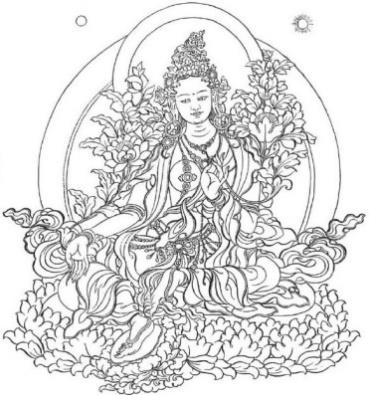
The first half of the verse should be understood as explained below. To whom does one ‘pay praise’? To the all-victorious liberator goddess, Tāra. Moreover, if one asks, what distinguishes her? It is a mind of great compassion, without duality, that swiftly benefits sentient beings. She is the ‘heroine’ who protects from all fears, dangers and fire and so on18, with the power and energy of unobstructed enlightened activity. Whose primordial awareness eyes are like a flash of lightning, swiftly moving, beholding and understanding all knowable phenomena. For that reason, Tāra the liberator is the one possessed with the enlightened activity who liberates all sentient beings from samsara. Likewise, she has knowledge, love, power and enlightened activity. Not only that, but she exemplifies having the power of all infinite good qualities. The goddess who possesses these qualities, was born from a blooming lotus sprung from the tears on the face of Avalokiteshvara, protector of the three worlds. The translator Namkha Zangpo19 said: ‘born from the tears on the face of the protector of the three worlds. The Goddess arose from a blooming lotus’. I will rewrite this phrase in an easy way to understand that is not the literal meaning. The form body of Tāra arose from the Dharmakāya, the protector of the three- worlds20.
此偈前半应依下文的解释来理解。向谁“礼赞”?向遍胜的救度女尊——度母。那么,若问她有何殊胜之处?就是无二的大悲心,迅速利益有情。她以无碍觉悟事业的威力与能量,护佑众生免于一切恐惧、险难、火灾等18,因此是“勇母”。她的本初智之眼如电光一闪,迅速运转,照见并了知一切所知法。因此,救度者度母具有令一切有情从轮回中解脱的觉悟事业。同样,她具备智慧、慈爱、力量与觉悟事业。不仅如此,她还体现出一切无量功德之力。具备这些功德的女尊,从三界怙主观世音面上泪水所生的盛开莲花中诞生。译师 南喀桑波19说:“从三界怙主面上的泪水中出生。女尊从盛开的莲花中出现。”我将以易于理解、而非字面义的方式重述这句话:度母的色身,从三界怙主法身中生起20。
本篇原注
18
The eight fears are 1) danger of pride and from lions, 2) danger of torpor and from elephants, 3) danger of anger and blazing fire, 4) danger of jealousy and poisons of snakes, 5) violence of false view and of thieves, 6) danger of insatiable greed and imprisonment, 7) danger of desire and waters, 8) danger of doubts and demons. The sixteen fears are the fear of the five elements (earth quakes, floods, wind, fire and fear of space), fear of weapons, tyrannous authority, criminals, spirits, elephants, wild animals, poisonous animals, sickness, accidents and untimely death, poverty and frustrations of hopes and plans.
八怖畏是:1)骄慢与狮子的危险;2)昏沉与大象的危险;3)愤怒与烈火的危险;4)嫉妒与蛇毒的危险;5)邪见与盗贼的暴力;6)贪得无厌与囚禁的危险;7)欲望与水的危险;8)疑惑与魔的危险。十六怖畏是对五大(地震、洪水、风、火及空)的恐惧,以及对武器、暴虐权势、罪犯、鬼神、大象、野兽、有毒动物、疾病、意外与非时死亡、贫困,以及希望和计划受挫的恐惧。
19
Lotsawa Namkha Zangpo (lo tsā ba nam mkha' bzang po),is said to have taught the Mirror of Poetry (snyan ngag me long) to Je Tsongkhapa at Bodong Monastery. He was also the student of Kālacakra lineage holder. The Blue Annals, Chapter Ten, mentions him in the account of the Kālacakra lineages and history:
据说,译师南喀桑波(lo tsā ba nam mkha' bzang po)曾在博东寺向宗喀巴大师教授《诗镜》(snyan ngag me long)。他也是一位时轮传承持有者的弟子。《青史》第十章叙述时轮传承与历史时提到他:
The lo tsā ba nam mkha' bzang po, the son of yu mo and student of byang chub rtse mo had a student named dpal 'jigs med grags pa. dpal 'jigs med grags pa was the teacher of two other important scholars rnam rgyal grags pa and bsod nams rnam par rgyal ba. bsod nams rnam par rgyal ba is noted for composing a seven volume commentary on the Vimalaprabhā, (a famous commentary on Kālacakra).
译师nam mkha' bzang po是yu mo之子、byang chub rtse mo的弟子,他有一名弟子dpal 'jigs med grags pa。dpal 'jigs med grags pa又是另外两位重要学者rnam rgyal grags pa与bsod nams rnam par rgyal ba的老师。bsod nams rnam par rgyal ba以撰写七卷《无垢光》(Vimalaprabhā,一部著名的时轮注疏)注释而闻名。
20
In the Tika, Tāranātha states about the definitive meaning:
在《蒂迦释》中,多罗那他谈到了义:
That is not the explicit, literal meaning, as it teaches the result. The literal meaning is ‘’liberates’ from samsara with ‘swift’ activity.
那不是显明的字面义,因为它讲的是果。字面义是以“迅疾”的事业,从轮回中“救度”。