第四偈:得胜顶髻 Fourth Verse: Victorious Crown Pinnacle
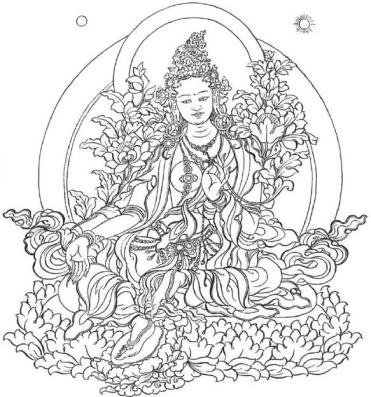
Praise to Tāra! Crown jewel of the Tathāgatas,
Whose victorious actions are infinite;
You attained the transcendent perfections, without exception,
Revered and relied on by the Victor’s heirs.
礼赞度母!如来顶上宝,
您的得胜事业无量无边;
您成就一切超越的波罗蜜,无一例外,
为胜者之子所敬奉、依止。
Emanating brilliantly from the crown jewel26 of the Tathāgatas27. The one with infinite beneficial qualities, who is completely victorious over all unharmonious and difficult conditions and situations; who manifests as the primordial awareness knowledge mantra/female deity. The female practitioner, Tāra, with your positive deeds of the Samboghakāya (Enjoyment Body)28, and with the knowledge mantra, you accomplish for beginningless sentient beings, without exception, the ten transcendent perfections29. The Victor’s children means those with the power of the tenth bodhisattva level.
The deep meaning is as follows: the descending and ascending levels of joy30are that which is called the glorious Tathāgata [One Gone Thus], and is that which ‘goes thus’ again and again [ascending and descending]. By dissolving the elements and the winds at the crown jewel pinnacle, one is completely victorious over all infinite things worthy of being abandoned. The ten perfections are transformed into the ten winds31. The bodhisattva Victors’ heirs, are transformed from the eye sense-spheres and so on, into primordial awareness32. This joined with the previous verse about the full autumn moons and so on, is the stage of samādhi33.
本篇原注
26
The Tibetan term for crown pinnacle is gtsug tor: this term means ushnisha, the protuberance on head of a buddha, one of the thirty-two major marks.
“顶髻”的藏文是gtsug tor,意为肉髻(ushnisha),即佛头顶的隆起,为三十二大相之一。
27
Tathāgata (de bzhin gshegs pa) translated as the ‘One Gone Thus’. It refers to the Buddha Nature, which according to the empty-of-other view (gzhan stong) followed by Tāranātha and the Jonang tradition, is continually present at all times as the ultimate nature of our mind. In the Tika commentary, Tāranātha refers more the subtle essence (dwang ma) and states that:
Tathāgata(de bzhin gshegs pa)译作“如是而去者”。它指佛性;依多罗那他与觉囊传承所持的他空见(gzhan stong),佛性作为我们心的究竟本性,时时持续存在。在《蒂迦释》中,多罗那他更着重于精微精华(dwang ma),并说:
The Tathāgata means the subtle essence of the five aggregates completely dissolve into the crown top and the assembly of the winds and the male and female seminal essences. Victorious over all the conventional phenomena. Thus, since she has discovered the Buddha body, the great Bodhisattvas also praise her. (de bzhin gshegs pa ste/_phung po lnga yi dwangs ma gtsug tor du yongs su thim pas khu rdul rlung gi tshogs pa zhig pa'i phyir/_kun rdzob kyi chos thams cad las rnam par rgyal bas/_des ni sangs rgyas kyi sku brnyes pa'i phyir rgyal sras chen pos kyang mchod pa'o/)
如来意为五蕴的精微精华完全融入头顶,以及诸风和男女精华的聚合。战胜一切世俗法。因此,她既已发现佛身,诸大菩萨也赞叹她。(de bzhin gshegs pa ste/_phung po lnga yi dwangs ma gtsug tor du yongs su thim pas khu rdul rlung gi tshogs pa zhig pa'i phyir/_kun rdzob kyi chos thams cad las rnam par rgyal bas/_des ni sangs rgyas kyi sku brnyes pa'i phyir rgyal sras chen pos kyang mchod pa'o/)
28
Sambhogakāya (saṃbhogakāya; longs sku) is defined as a 'form body' (rupakāya) of a buddha, which appears only to bodhisattvas and is the basis for the arising of the nirmanakāya. It is adorned with the major signs and minor marks. It is one of the four kāyas (Skt. catuḥkāya; sku bzhi) are the: 1) dharmakāya (chos kyi sku), 2) sambhogakāya (longs spyod rdzogs pa’i sku), 3) nirmanakāya (sprul pa’i sku), and 4) svabhavikakāya (ngo bo nyid kyi sku).
报身(saṃbhogakāya;longs sku)被定义为佛的一种“色身”(rupakāya),只向菩萨显现,也是化身生起的基础。它以大相与小随形好为庄严。它是四身(梵文catuḥkāya;sku bzhi)之一,四身为:1)法身(dharmakāya;chos kyi sku);2)报身(sambhogakāya;longs spyod rdzogs pa’i sku);3)化身(nirmanakāya;sprul pa’i sku);4)自性身(svabhavikakāya;ngo bo nyid kyi sku)。
29
The ten perfections/pāramitas, are the six commonly referred to perfections as well as 7) means (thabs), 8) strength/ power (stobs), 9) aspiration (smon lam), 10) primordial awareness (ye shes).
十波罗蜜即通常所说的六波罗蜜,再加上7)方便(thabs)、8)力(stobs)、9)愿(smon lam)、10)本初智(ye shes)。
30
The four joys (catvārimuditā; dga' ba bzhi) are four increasingly subtle experiences of bliss-emptiness connected with the advanced practices of tsa-lung; they completely transcend ordinary feelings of joy or pleasure. They are: 1) joy (muditā; dga' ba), 2) supreme joy (Skt. pramuditā; mchog dga'), 3) special joy (viśeṣamuditā; khyad dga') and 4) innate joy (sahajamuditā; lhan skyes kyi dga' ba). They are experienced when the white bodhichitta drop, (also called white essence), ascends from the lowest chakra to the navel, heart, throat, and crown chakras. The place of joy (dga' ba'i sa), sometimes referred to as the female genitals.
四喜(catvārimuditā;dga' ba bzhi)是与高级脉风修法有关、愈益微细的四种乐空体验;它们完全超越普通的欢喜或愉悦感受。四喜为:1)喜(muditā;dga' ba);2)胜喜(梵文pramuditā;mchog dga');3)殊喜(viśeṣamuditā;khyad dga');以及4)俱生喜(sahajamuditā;lhan skyes kyi dga' ba)。当白菩提心明点(也称白色精华)从最低的轮上升至脐、心、喉与顶轮时,便体验到这些喜。“喜处”(dga' ba'i sa)有时指女性生殖器。
31
There are taught to be many channels and minor centres around the body, but these are the main ones, and also the ones that feature in the meditation practices. Winds in the purified form are called awareness-winds, and in the impure form, action-winds. There are ten of these main winds moving within all these channels. One can also understand these as ten types of winds that move within the channels of the body. The names of these ten winds and the elements associated with them, are:
教说身体周围有许多脉与小中枢,但这些是主要者,也是禅修中所用者。净化形态的风称智风,不净形态的风称业风。在所有这些脉中流动的主要风共有十种,也可将它们理解为在身体脉中运行的十类风。这十风的名称及其对应元素为:
- Prāṇavāyu (srog) – space
- Prāṇavāyu(srog)——空
- Samānavāyu (mnyam gnas) – wind
- Samānavāyu(mnyam gnas)——风
- Udānavāyu (gyen rgyu) – fire
- Udānavāyu(gyen rgyu)——火
- Vyānavāyu (khyab byed) – water
- Vyānavāyu(khyab byed)——水
- Apānavāyu (thur sel) – earth
- Apānavāyu(thur sel)——地
- Nāgavāyu (klu) – awareness
- Nāgavāyu(klu)——觉知
- Kūrmavāyu (rus sbal) – wind
- Kūrmavāyu(rus sbal)——风
- Kṛikaravāyu (rtsangs pa) – fire
- Kṛikaravāyu(rtsangs pa)——火
- Devadattavāyu (lhas byin) – water
- Devadattavāyu(lhas byin)——水
- Dhanañjayavāyu (nor rgyal) – earth
- Dhanañjayavāyu(nor rgyal)——地
32
In the Tika commentary: The meaning of Victor’s Children means the winds of the sense spheres and realms all enter into the luminous clarity.
《蒂迦释》中说:“胜者之子”的意思,是诸处与诸界之风全部进入光明。
33
Samādhi (ting nge dzin), translated as meditative absorption, Tāranātha is referring to the final stage of the six vajra-yogas. See footnote 12 above. Jamgon Kongtrul (HARDING 2007: 323) says:
Samādhi(ting nge dzin)译作三摩地,多罗那他指的是六支金刚瑜伽的最后阶段,见上文注12。蒋贡康楚说(HARDING 2007:323):
The branch of meditative absorption is the unity of the empty- forms and unchanging bliss.
三摩地支是空色与不变乐的合一。
And:
又说:
The Meaning of the Name
名称的含义
Sam›dhi is meditative absorption. It also has the connotation of total adherence to a state of equipoise, and is therefore free of subject-object dualism. So it refers to the mind abiding in a state where subject and object are undifferentiated.
Samādhi即三摩地。它也含有完全安住于平等住状态之义,因此没有能所二元。所以,它指心安住于能所无别的状态。
The Time for Meditation
修习时机
The time for this meditation is at the culmination of the branch of recollection, when one is able to immediately produce unchanging bliss.
此修习的时机是随念支臻至圆满之时,此时能立即生起不变乐。