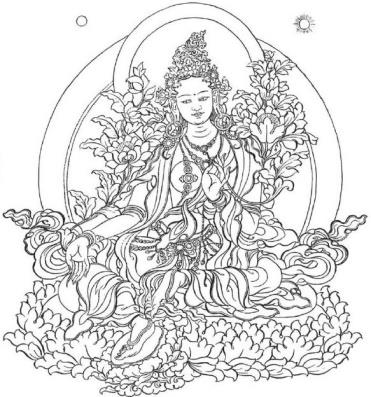
第十一偈:以“Hūṃ”召摄众生 Eleventh Verse: Summoner of Beings ‘Hūṃ’
Praise to Tāra! Able to summon
all local earth protectors and their retinue;
frowning and shaking with the letter 'Hūṃ',
liberating all impoverished from misfortune.
礼赞度母!能召摄
一切护地神与其眷属;
以“Hūṃ”字颦眉震动,
令一切贫困者脱离厄运。
The goddess with her mantra, is the one who has the power to summon49 and bring under her control the retinue of the kings of the local earth protectors, the earth goddesses, the nāgas50 who live underground, the demi-gods and vidyadharas and dākinīs, this whole assembly. Frowning and shaking means the frowning goddess with the energy force of the letter HŪṂ. She who liberates and pacifies, without exception, the suffering of poverty and destitution of all impoverished sentient beings; she expands and increases the siddhis of great treasures and auspicious and abundant resources.
The hidden meaning is as follows: The earth protectors and rulers of the underground, means the atomic, essential energy51 that is ’summoned’ by stabilising the essential luminous energy from the crown until the jewel tip. The terms frowning and shaking HŪṂ means the frowning and shaking essential energy of the moon that is stabilised at the essential drop at the point between the eyebrows until the crown of the head. Liberating all impoverished means the samādhi such as the ‘Sky-Treasury’52 and so on.
本篇原注
49
The Tibetan word is ‘gugs. It can also be translated as to’ summon’, ‘draw in’ or ‘gather’.
藏文词为 ‘gugs,也可译为“召唤”“引入”或“聚集”。
50
As in Hinduism, the Buddhist nāga generally has the form of a great cobra, usually with a single head but sometimes with many. Some of the nāgas are capable of using magic powers to transform themselves into a human semblance. The nāga is sometimes portrayed as a human being with a snake or dragon extending over his head.
与印度教相同,佛教的龙通常呈大眼镜蛇的形态,一般只有一个头,但有时也有多个头。有些龙能够运用神通,将自己变成人的形貌。龙有时也被描绘成人形,头上伸出蛇或龙。
51
The Tibetan word is rdul gyi dwang ma, this can mean energy, essence, sperm and so on.
藏文词为 rdul gyi dwang ma,可以指能量、精华、精子等。
52
nam mkha' mdzod kyi ting nge 'dzin.
nam mkha' mdzod kyi ting nge 'dzin。
53
White (dkar) and red (dmar) here means the white seminal element of the man and the red seminal element of the woman. Here again, Tāranātha connects it with the final stage of the six vajra-yogas.
此处的白(dkar)与红(dmar),指男性的白色精质与女性的红色精质。多罗那他在这里又将其与六支金刚瑜伽的最后阶段联系起来。