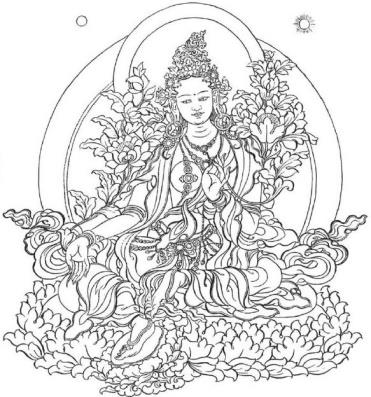
第十五偈:安乐、善妙与寂静 Fifteenth Verse: Blissful, virtuous and peaceful
Praise to Tāra! Blissful, virtuous, and peaceful,
Whose field of activity is ‘gone beyond suffering’.
Perfectly endowed with OM and SVAHA
Completely obliterating horrendous acts.
礼赞度母!安乐、善妙而寂静,
以“超越苦”为行境,
圆满具足 OM 与 SVAHA,
彻底消除可怖恶业。
This verse means the Bhagavati is eternally blissful , virtuous and peaceful; the supreme peace of ‘nirvana’; ‘gone beyond suffering’. The one whose meditative equipoise on the expanse of the truth of cessation, embodies the field of activity of peace. Therefore, she is the one who brings bliss to wanderers in this life and generates virtue in them for the sake of the next life. She is the one who shows the path of peace to the fortunate ones. The one who establishes them in the field of activity of the sacred peace of the result of the non-abiding nirvana. Also, she is the goddess who chants the knowledge mantra, whose perfect recitation SVAHA and OM, completely obliterates horrendous acts and the vast suffering that is their result. Repelling those before with TRAT and slaughtering after with PHAT, transforms other activities.
此偈意为薄伽梵母恒常安乐、善妙而寂静;即“涅槃”的最胜寂静,“超越苦”。她于灭谛之界中平等安住,体现寂静的行境。因此,她令流转者于今生获得安乐,并为来生而令其生起善德。她向具缘者示现寂静之道,将其安立于无住涅槃之果的神圣寂静行境。她也是持诵明咒的女尊,以圆满持诵SVAHA与OM,彻底消除可怖恶业及其所生的广大苦果。在前以TRAT驱遣,在后以PHAT诛杀,转化其他事业。
The definitive, ultimate meaning is as follows: blissful means the primordial awareness of individual sense withdrawal62, virtuous means mirror primordial awareness, peaceful means equality primordial awareness. The peace of having gone beyond means the expanse primordial awareness. The completely obliterating horrendous acts is the primordial awareness that accomplishes actions63. The invincible sound of the knowledge mantra of OM and SVAHA exemplifies the dawning of infinity. Conqueror of negative actions and so on, means accomplishing the result for the benefit of sentient beings.
本篇原注
62
The first part of the name in Sanskrit, 'prati' means 'individually'; the second part 'ahara' means, according to context, 'to gather', 'eliminate', 'consume', 'sever', 'grasp'; in this instance it means 'gather'. Combined together as pratyahara, the meaning is 'gather all together', withdrawal. Cutting the connection between the five normal senses and their objects, withdrawing consciousness from the objects, one experiences through five other awareness senses five objects that have the nature of radiant light – the meaning here being to consume or grasp. In brief, the meaning is that by withdrawing the mental attention away from normal appearances, one starts to experience appearances of awareness. As it says in the tantra: "In pratyahara there is no involvement at all with the ten physical subjects and objects".
梵语名称的第一部分 prati 意为“各别”;第二部分 ahara 依语境可以指“聚集”“消除”“消耗”“切断”或“摄取”,此处意为“聚集”。两者合为 pratyahara,意为“全部聚拢”,即收摄。切断通常的五根与其对境之间的联系,将识从对境收回,便通过另外五种智根,体验五种以灿烂光明为本性的对境——此处的意思是消纳或摄取。简言之,将心的注意力从通常的显相中收摄回来,便开始体验智的显相。如密续所说:“在收摄中,全然不涉入十种物质性的能取与所取。”
And:
又说:
The essence of pratyahara is the development of the ability to gather the ten winds into the central channel by means of the three non-conceptual tranquillities. This consists of the two day and night yogas, because all things are categorised into pairs of method and understanding: the creation and destruction of the physical worlds, the birth and death of beings, the two passages of the Sun, the two fortnights of a month, daily day and night, the right and left (female and male) kinds of orgasm, odd and even ascendants and (internal) wind changes, and so forth. For this reason day and night yogas are necessary…
收摄的本质,是借助三种无分别寂静,培养将十风聚入中脉的能力。这包括昼、夜两种瑜伽,因为一切事物皆可归为方便与智慧的成对类别:物质世界的生成与毁灭、有情的出生与死亡、太阳的两种运行、每月的两个半月、每日的白昼与黑夜、右与左(女与男)两类性高潮、奇数与偶数的上升位,以及(内在)风的变化等等。因此,昼夜瑜伽是必要的……
Kongtrul gives the exact same definition as Tāranātha in terms of the meaning of the term and states (p299) that:
康楚对这一术语的释义与多罗那他完全相同,并在第299页说道:
With the gaze of an u˝nı˝acakrin and the vital points of binding the bodily functions, all connections between the ordinary five sense organs and their five objects are individually severed and the consciousnesses that stray to objects are drawn inside. Five other faculties that are the nature of pristine awareness then interact with fi ve alternate objects that are the nature of luminous clarity. Those stages of yoga cause the right and left channel mandalas of method and wisdom to cease within the central channel, and the ten signs are quickly completed.
以 u˝nı˝acakrin 的凝视方式及束缚身体机能的要点,将通常的五根与其五种对境之间的一切联系逐一切断,并将驰散于对境的诸识收摄入内。另有五种以本初智为本性的根,随即与另外五种以光明为本性的对境相接。这些瑜伽阶段使左右脉的方便与智慧曼荼罗在中脉中止息,十相便迅速圆满。
63
Here Tāranātha is referring to the five primordial awarenesses (ye shes lnga):
此处,多罗那他指的是五种本初智(ye shes lnga):
- The primordial awareness of the expanse of reality (chos dbyings kyi ye shes or dharmadhatu jñana).
- 法界体性智(chos dbyings kyi ye shes 或 dharmadhatu jñana)。
- the mirror-like primordial awareness (me long gi ye shes or adarsha jñana).
- 大圆镜智(me long gi ye shes 或 adarsha jñana)。
- the primordial awareness of discernment (sor rtog pa'i ye shes or pratyavekshana jñana).
- 妙观察智(sor rtog pa'i ye shes 或 pratyavekshana jñana)。
- the primordial awareness of sameness (mnyam nyid kyi ye shes or samata jñana).
- 平等性智(mnyam nyid kyi ye shes 或 samata jñana)。
- and the primordial awareness of accomplishment (bya ba'i ye shes or krtyanusthana jñana).
- 以及成所作智(bya ba'i ye shes 或 krtyanusthana jñana)。