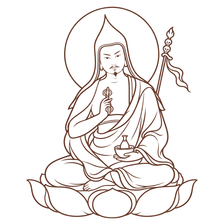
Mantra Recitation, from The Drupchen Digest
原刊阅读条件
Only read if you have received a Vajrakilaya empowerment
仅限已领受金刚橛灌顶者阅读。
One sunny, summer morning in Lerab Ling, Rinpoche – who was, as always, intent on remaining absolutely faithful to the practice methods of the great masters of the past – read the prescribed section of the Drupchen Digest that’s traditionally recited during a drupchen. A Drupchen Digest is a compilation of quotations that have been gathered and categorized according to where they should be read during the ritual practice; and its purpose is to inspire participants at different stages of the practice.
列绕林一个阳光灿烂的夏日早晨,仁波切一如既往,坚持完全忠实于往昔大德的修持方法,宣读了《大修摘要》中传统上于大修期间诵读的指定部分。《大修摘要》汇集了许多引文,按仪轨修持中应诵读的位置分类,旨在不同修持阶段激励参与者。
激励修持 Inspiration to Practise
According to the drupchen tradition we are following, a specific part of the text called the Drupchen Digest[1] must be shared with practitioners during a session of mantra recitation. From his throne at the head of the gathered practitioners, the vajra master, or the vajra regent, is directed to read the relevant passage.
依照我们遵循的大修传统,念咒座中,必须向修持者宣读《大修摘要》[1]这一文本的特定部分。规定由金刚上师或金刚补处,在大众前方的法座上宣读相关段落。
The practice is divided into three stages. These three stages are related to enlightened body, speech and mind. When the practice reaches the stage of enlightened speech – the repetition of mantra – the vajra master reads from the Digest while everyone else quietly recites the mantra. So, out of respect for the traditional way drupchens have been done in the past, this is what we have been doing here. I will now tell you what the text says.
修法分为三个阶段,分别对应觉悟身、语、意。修到觉悟语的阶段,即反复持咒时,金刚上师宣读《摘要》,其余人则轻声念咒。因此,为尊重过去举行大修的传统方式,我们在这里一直如此行持。现在,我来告诉你们文本说了什么。
轮回 Samsara
From time immemorial, we have all been floundering around in the great ocean of suffering that are the three realms of samsara, entirely unable to free ourselves from it. How did that happen? We are trapped in samsara because we cannot control our minds – I am in samsara because I have not taken control of my mind. Thoughts are like the ocean’s waves, and relentless waves of thoughts arise because we don’t control our minds. As long as these thoughts continue to arise – until they are exhausted – there is no path to liberation. Therefore, liberation is impossible.
自无始以来,我们都在三界轮回的大苦海中挣扎,完全无法自拔。为何会这样?我们被困在轮回,是因为无法调伏自心——我在轮回中,是因为未曾调伏自己的心。念头像海浪;由于不调伏心,念头便如波浪不断生起。只要这些念头继续生起,尚未穷尽,便没有解脱之道。因此,不可能解脱。
In The Way of the Bodhisattva, the son of the victorious ones, Shantideva said:
胜者之子寂天在《入菩萨行论》中说:
Our main practice, said Shantideva, should be the discipline of guarding our own minds. He stresses the great benefit that focussing on learning to control our minds will bring, and says that this should be our main concern.
寂天说,我们的主要修持,应是守护自心的律仪。他强调,专注学习调伏心,会带来极大利益,这应当是最主要的关注所在。
大修 Drupchen
There are many special practices we can use to gain control of our minds. The one we’re practising here is drupchen – or as it says in the text...
有许多特殊修法可以用来调伏自心。我们这里修的是大修,或如文中所说:
...the antidote that we apply is the drupchen practice of Secret Mantra.
……我们采用的对治,是秘密真言大修。
In this practice, we recite the mantra as we experience our bodies in the form of the deity; sound is mantra, mind is samadhi, and we ourselves are indivisible from the yidam, Glorious Vajrakumara. You should practice...
修法时,体验自己的身体为本尊形相,同时念咒;声音是咒,心是三摩地,自己与本尊吉祥金刚童子无二无别。应当这样修:
...undistractedly, and do not recite the mantra with ordinary perceptions.
……不散乱,不以凡俗知见念咒。
If you practise in a drupchen with faith, pure perception and sincere concentration, you will not need to practise for months or even years before you attain accomplishments; seven days of intensive group practice brings the same benefit as seven years of individual practice. This is mentioned in the prophecies contained in the Essentialization of All the Wisdom of the Gurus terma cycle, which were revealed by Tertön Sangyé Lingpa. It is one of the most famous and profound termas from the Land of Snows. It is so precious that it has been compared to gold.
若以信心、清净观和真诚的专注参加大修,不必修上数月甚至数年才得成就;七天密集共修,能带来等同七年个人修持的利益。伏藏师桑杰林巴所取《上师意集》法类中的授记,便说到了这一点。这是雪域最著名、最甚深的伏藏之一,极其珍贵,被比作黄金。
My teacher used to say that the benefit of doing seven days of drupchen practice is the same as the benefit you accumulate during seven years of individual retreat. But, he added, practitioners need to be told why this is so. Think of an object so big that one person cannot lift it. Now think of how a group of people working together can move it instantly. Likewise, when many people with faith, pure perception and pure samayas – yogis and yoginis, masters with great realization, people with some realization, and others with a little realization – concentrate and sincerely practise samadhi together in a Secret Mantra Vajrayana practice, the benefit is that...
我的老师过去常说,修七天大修的利益,等同独自闭关七年积累的利益。不过,他也说,必须向修持者说明原因。想象一件大到一个人搬不动的物品,再想一想,一群人合力便能立刻搬动。同样,当许多具信心、清净观与清净三昧耶的人——瑜伽士、瑜伽母、证悟极高的上师、有一些证悟者与略有证悟者——一同专注、真诚地修习秘密真言金刚乘的三摩地,其利益是:
To start with, the Essentialization of All the Wisdom of the Gurus says that all those who participate in the drupchen, from the teacher or ‘vajra king’ and the whole assembly, down to the ‘vajra sweeper’ (in drupchen jargon) – basically everyone involved at every level – must enter into the seven-day practice joyfully and single-mindedly. They must also avoid any thought of tiredness, disappointment, and so on.
首先,《上师意集》说,参加大修的所有人,上至老师或“金刚王”及全体大众,下至大修用语所称的“金刚清扫者”——也就是各层面参与的一切人——都必须欢喜、专一地投入七天修持。也须避免疲倦、失望等等念头。
Second, the text says that we should cultivate a sense of joy because not only have we had the great good fortune of having attained a human birth, met qualified teachers and entered into the mandala of Vajrayana practice – all which are very difficult – we also have the rare opportunity of joining this gathering to do a great drupchen practice of accumulation. We have the chance to put all our energy and enthusiasm into a practice that within seven days can bring the same benefit that an individual would take seven years to accumulate – this is what Guru Rinpoche said in his unerring vajra words. So, surely, the chance to practise in a drupchen is a cause for great joy! Recognizing just how extraordinary an opportunity this is, who would not want to be cheerful and to celebrate?
其次,文中说应培养欢喜之心,因为我们不仅极为幸运地得了人身、遇见具德上师、进入金刚乘修持的坛城——这一切都极难得——如今还有难得机会,加入大众,举行积集资粮的大修。我们有机会投入全部精力与热忱,修持一种七天便能获得个人七年所积利益的法门;这是莲花生大师以无误金刚语所说。因此,有机会参加大修,当然是极大欢喜之因!认识到这是多么殊胜的机会,谁会不想欢喜庆祝?
There are still many accounts from earlier in this ‘Fortunate Kalpa’, about how Guru Rinpoche and other great masters presided over similar intensive group practices in Oddiyana, Zahor in India, and elsewhere. As a result of their practice, entire regions were emptied because all the local human beings, birds and wild animals attained the vidyadhara levels of realization at the same time.
This information is offered to inspire us with joy at the beginning of the practice – it’s a bit like watering flowers.
讲这些,是为了在修持开始时激发欢喜,有点像给花浇水。
发心 Motivation
Now, the main point: we must always focus on accumulating merit. This means that at all times and in all circumstances we must gather what is virtuous and positive, and reject what is negative. The actual producer of positivity and negativity is the mind. It is most important, therefore, that mind gathers positivity and rejects anything negative or that isn’t virtuous.
现在说要点:必须始终专注积累福德。这意味着,在一切时候、一切情况下,都须积集善与正面之事,舍弃恶。真正产生善恶的是心。因此,最重要的是让心积善,舍弃一切恶或不善。
So, how do we prepare mind for practice? Before doing a specific practice like approach and accomplishment, we must first think about how our practice will help others. In other words, we need to generate and maintain a genuine sense of altruism.
那么,如何使心为修持做好准备?进行念修与成就等特定修法之前,必须先想,修持将如何帮助他人。换句话说,需要生起并保持真实利他心。
觉悟身 Enlightened Body
The yoga of the deity: generating its form (kaya)
[...] here is what you need to do...
本尊瑜伽:生起其身相
[…]应当这样做……
明晰显现 Clear Appearance
The text includes pith instructions, which are the direct and very practical advice that masters give their students personally. It begins with pith instructions for kyerim meditation on the enlightened body – basically, how to meditate on the form of the deity. Where do these pith instructions come from? What is the source?
文中包含窍诀,也就是上师亲自给予弟子直接、实用的教导。首先是观修觉悟身的生起次第窍诀,基本上就是如何观修本尊身相。这些窍诀来自哪里?出处是什么?
The Mandala of the Eight Great Deities: The Complete Gathering of Vidyadharas teachings of the Northern Treasures tradition mention that Guru Rinpoche said:
《八大本尊坛城·持明总集》,属于北伏藏传统;其中提到,莲花生大师说:
In the beginning, meditate on the form of the deity.
When the form of the deity appears clearly in the mind,
Ordinary thoughts disappear.
最初观修本尊身,
本尊身相心中明现时,
凡俗念头即消失。
This means that you should start by concentrating on establishing a clear visualization of the form of the deity and not worry too much about anything else.
意思是,最初应专注于建立清晰的本尊身相观想,不必过多顾虑其他。
In the case of the great glorious Vajrakumara, visualize that he has three faces and six arms: his upper right hand holds a nine-pronged vajra, his middle right hand holds a five-pronged vajra, his upper left hand holds a mass of flames, his middle left hand holds a khatvanga, and his lower two hands roll a phurba the size of Mount Meru. His four legs are in the stamping posture, flames of vajra fire blaze from every part of his body and each pore is marked with half vajras. He has wings and is in union with his consort, Diptachakra. She is pale blue; in her right hand she holds an utpala flower and in her left a skull-cup filled with blood, which she offers to Vajrakilaya’s lips. In other words, bring to mind a mental image of the deities as they appear on a thangka and meditate on that image.
以大吉祥金刚童子为例,观想他三面六臂:右上手持九股金刚杵,右中手持五股金刚杵,左上手持火焰聚,左中手持卡章嘎,下面两手搓转一支须弥山大小的普巴橛。四足作踩踏姿势,遍身燃起金刚火焰,每一毛孔都标以半截金刚杵。他有双翼,与佛母 炽燃轮 双运。佛母浅蓝色,右手持乌巴拉花,左手持满盛鲜血的颅器,献至金刚橛唇边。也就是说,心中现起唐卡所绘诸尊的形相,并观修这一形相。
The reason we hang thangkas needs to be clarified. The purpose of thangkas is not to provide decoration. Thangkas aren’t put up to make a room look nice, they are there to support our practice...
悬挂唐卡的原因,需要说明清楚。唐卡的目的不在装饰,不是为使房间好看,而是作为修持所依:
...[the] practice support samaya drawing of the deity.
……作为修持所依的本尊三昧耶画像。
‘Practice support’ means a support for the practice of visualizing the deity.
“修持所依”,是指观修本尊的所依。
How do we use a thangka as a support for our visualization? Place the thangka in front of you, then “focus mind, wind-energy and gaze one-pointedly” at the image for a long time. You should look at it until you can see it clearly in your mind. When you close your eyes, check whether or not the image of the deity appears vividly in your mind’s eye. If it doesn’t, repeat the process. By doing this over and over again for a long time, you will eventually be able to visualize the deity. As Shantideva said:
如何以唐卡为观想所依?将唐卡放在面前,然后长时间地对着画像“心、气与目光专注一处”。一直看,直到心中能够清楚见到。闭眼时,查看本尊形相是否鲜明地出现在心眼中。若没有,就重复这一过程。长时间反复如此,最终便能观想本尊。如寂天所说:
By training in this way, all the details of the deity will eventually appear clearly in your mind exactly as they appear on the thangka – including the colours, implements and so on – even when you aren’t looking at the thangka.
如此训练,最终,本尊的一切细节,包括颜色、法器等,都会如唐卡所绘一般清楚现于心中,即使不看唐卡也是如此。
Your visualization will become clearer and clearer as you go through nine phases – but today there is no need to explain these nine steps in detail[5] . All you need to know is that at the beginning, your mind may be so unsettled that no images appear in it at all, and instead becomes ensnared by one thought after another. But as you keep practising, mind will gradually settle until eventually it rests as calmly as a tranquil lake. And in the end, your mind will be able to sustain a perfect visualization of the deity.
历经九个阶段,观想会越来越清晰,但今天不必详细讲这九个步骤[5]。只须知道,起初,心或许如此不安定,完全没有形相显现,反而被一个又一个念头缠住。但持续修习,心就会逐渐安住,最终如平静湖面般安宁。最后,心便能保持完美的本尊观想。
Having said that, simply to maintain a stable picture of the deity in your mind is not enough. Once you can bring a clear image to mind, you should then train yourself to make it larger and larger until it is as vast as Mount Meru, and smaller and smaller until it shrinks to the size of a mustard seed. Then imagine the deity dancing, or eating and drinking, striking all kinds of postures and appearing in different situations. At times you should try to imagine the deity with a single face and two arms, at others with an infinite number of faces and arms – do this until you can picture the deity with a million of each. These are some of the ways in which you should train yourself to increase the strength of your practice.
话虽如此,仅仅在心中稳定保持本尊形相,还不够。一旦能令清晰形相现于心中,就应训练令它越来越大,直到广大如须弥山;又越来越小,直到缩如芥子。然后想象本尊起舞、饮食,摆出各种姿态,出现在不同情境中。有时试着观想本尊一面二臂,有时则有无数面与臂,一直做到能够观出各一百万面、臂。这些都是训练自己、增强修持力量的方法。
You’ll probably find that as soon as you can picture one part of the deity, you’ll lose the rest – as you imagine the head you lose the feet, as you think of the right hand, you forget the left, and so on. But if you persevere, eventually that will no longer be a problem.
你大概会发现,一观出本尊某个部分,其他部分就丢了:观头时忘了脚,想右手时忘了左手,等等。但若持之以恒,最终就不再有这个问题。
To give you an example: when I think of my father, I don’t have to think of each of his features one by one, his entire image instantly appears in my mind. I don’t have to say to myself, “his head was like this, his arms were like that, his legs looked like this” and so on. Although this is not exactly what happens when you visualize, the example of thinking about someone you know might be helpful.
举例来说,想到父亲时,我不必逐一想他的每个特征,完整形相立刻便现于心中。不必对自己说:“他的头是这样,手臂是那样,腿又长这样”,等等。虽然这与观想时发生的情形并不完全相同,但忆念熟人的例子,或许有所帮助。
If you train yourself in this way and become more and more familiar with kyerim practice, you will eventually be able to hold a visualization clearly in your mind.
如此训练,对生起次第修持越来越熟悉,最终便能在心中清晰保持观想。
This relates to a statement made in The Complete Gathering of Vidyadharas terma,
这与《持明总集》伏藏中的一句话相应:
In the beginning meditate on the form of the deity.
最初观修本尊身。
The text goes on to say that when mind is occupied with thinking about the deity, any other thought or concept – destructive emotions of desire, anger and so on, and all the thoughts that habitually arise – naturally disappears because the mind is busy with the visualization. This statement is based on the simple fact that mind is incapable of holding two different thoughts simultaneously; therefore holding an image of the appearance of the deity in your mind will necessarily eliminate ordinary thoughts.
文中接着说,心专注忆念本尊时,其他任何念头或概念——贪、嗔等烦恼及惯常生起的一切念头——自然消失,因为心正忙于观想。这一说法根据的是一个简单事实:心无法同时持有两个不同念头。因此,心中保持本尊形相,必然会消除凡俗念头。
稳固的本尊慢 Stable Pride
Next, says The Complete Gathering of Vidyadharas, meditate on vajra pride.
《持明总集》说,接着观修金刚慢。
In the middle, cultivate the pride of the deity.
When pride becomes stable,
You will gain control of yourself.
中间培养本尊慢,
本尊慢稳固时,
便能自主。
Here again, I must explain something. You might ask, how do I cultivate the pride of the deity? Or even, what right do I have to feel the pride of being the deity?
这里,我又必须解释一下。你也许会问,如何培养本尊慢?甚至会问,我有什么资格具有自己是本尊的自信?
In the Secret Mantra Vajrayana tradition the ‘ground’ – the basis for enlightenment of each and every sentient being, from Samantabhadra down to the silkworms – is buddha nature. From this point of view, everyone is the same. According to the Buddha’s teaching, buddha nature is permanent, it pervades everything and it is spontaneously present.
It is because all sentient beings have the ground of buddha nature that they are capable of attaining enlightenment. If they did not have such a basis, they would never be able to become buddhas. A stone doesn’t contain oil; no matter how much you press or grind a stone, whatever tools or machinery you use, you will never be able to extract even a drop of oil. A sesame seed, on the other hand, has the potential to produce oil, which means that by pressing it, sesame oil will eventually be extracted.
秘密真言金刚乘传统中,上自普贤、下至蚕虫,每一众生觉悟的基础,也就是“基”,都是佛性。从这一观点看,大家都一样。依佛陀教法,佛性常住、遍及一切、任运自成。
正因一切众生具有佛性之基,才能觉悟。若没有这样的基础,就永远不能成佛。石头不含油;无论如何挤压、研磨,无论使用什么工具或机器,都不可能榨出哪怕一滴油。相反,芝麻具有出油的潜能,因此经过压榨,最终就会出芝麻油。
We can’t perceive the enlightened ground of our buddha nature because it is slightly obscured by cognitive and habitual tendencies. When the two obscurations are removed, we are ‘buddha’ – of this there is no doubt. Once the two obscurations are purified and the natural ground of buddhahood manifests, all the qualities of enlightenment – such as the thirty-two major and eighty minor marks – manifest spontaneously. Like the sun emerging from behind the clouds, the sun of buddhahood appears complete with all its qualities, such as light and so on; nothing is ‘created’.
Some say that the qualities of buddhahood are always present as the natural attributes of the ground of buddha nature. Others disagree. It’s a controversial issue, but in my opinion and in the opinion of all my teachers, these qualities are intrinsic to the ground and are by nature permanent and unchanging.
有人说,佛果功德始终存在,是佛性之基的自然属性;也有人不同意。这是一个有争议的问题。不过,依我及我所有老师的看法,这些功德内在于基,其本性常住不变。
When the ground is obscured, obscurations don’t affect it in any way. The ground – the buddha nature – of a buddha is exactly the same as our ground. We therefore practise kyerim and dzogrim in order to remove the defilements that obscure the ground. We clear away all our obscurations so that we become truly inseparable from the yidam deity. The deity is simply something that appears in our mind and is not in any way different from our mind, the buddha nature. Based on that understanding, we meditate on vajra pride. We don’t think of the deity as superior to ourselves (that we are inferior), and we don’t think of the gulf separating the deity from us as “the difference between heaven and earth”. To think in those terms is to fall into the view of the lower classes of tantra, like the Kriya and Charya, and by thinking like that we will never arrive at the true practice of kyerim that’s found in the Mahayoga.
The last line of the terma explains the benefit of meditating in this way.
伏藏的最后一句,说明如此观修的利益:
You will gain control of yourself.
便能自主。
If we possess something very valuable but don’t know about it, we don’t really own it. The moment we learn of its existence, by taking possession of it we gain control of it. It is like a priceless treasure buried beneath the house of a very poor man. Unless he knows the treasure exists, he can’t use it to end his poverty – which means that it’s knowing about the treasure that eliminates the poverty. Likewise, once I know I have buddha nature, I will gain control of myself.
若拥有极有价值之物,却不知道,就不算真正拥有它。一旦知道它存在,加以掌握,就能支配它。就像极贫穷的人家下埋有无价宝藏;若不知道宝藏存在,就无法用它结束贫穷。也就是说,知道宝藏,才消除了贫穷。同样,一旦知道自己具有佛性,我便能自主。
观修加持 Meditating upon the Blessings
In conclusion the Complete Gathering of Vidyadharas terma adds,
最后,《持明总集》伏藏补充说:
In the end, meditate upon the deity’s blessings.
最后观修本尊加持。
The text described three stages: “in the beginning”, “in the middle...”, and “at the end.” At the end, we must meditate upon the deity’s blessings. How do we meditate on blessings? By thinking about the deity’s blessings. The power of those blessings then changes our perception of ourselves and others. What is this transformation like? To put it briefly, transformation happens when your perception changes so that it is no longer like the perceptions of your ordinary mind. When you no longer see objects as you ordinarily would and instead see them as naturally pure, their true nature, wisdom. Once that happens, you will have received the blessings of the deity. Other than that, there is nothing tangible called ‘blessing.’
文中描述了三个阶段:“最初”“中间”及“最后”。最后,必须观修本尊加持。如何观修加持?就是忆念本尊加持。加持之力随即改变我们对自他的知见。这种转变是什么样的?简而言之,当知见改变,不再像凡心的知见,转变便发生了。当不再如平常那样看待事物,而是见其自然清净、真实本性,也就是智慧,一旦如此,便得到了本尊加持。除此之外,没有一个可触及的东西叫作“加持”。
The ultimate result is attained when...
当以下情形发生时,便证得究竟果:
You meet the absolute truth, the wisdom of your own rigpa.
面见胜义谛,即自觉性的智慧。
This means that the potential for realizing the ultimate truth is in your own mind. The essence of your own rigpa, primordial wisdom (the ultimate, primordial purity) is made manifest, thereby severing the root of samsara and nirvana. Literally, we ‘meet’ with rigpa – which is an honorific way of saying that we see the ultimate truth. In one of the termas of his new tradition, Zurmang Chögyam Trungpa used the expression “come to see the great eastern sun”, which amounts to the same thing.
这意味着,证悟胜义谛的潜能就在自心。自觉性的本质、本初智慧,即究竟的本初清净,得以显露,从而斩断轮回与涅槃之根。按字面说,我们“面见”觉性,这是尊敬的说法,意思是见到胜义谛。苏莽·确吉创巴在其新传统的一部伏藏中,用了“得见东方大日”的表达,意思相同。
So, training in these three – clarity of appearance, stable confidence and remembering the purity – form the basis of kyerim; and kyerim is then applied in the four stages of approach and accomplishment.
所以,训练这三者——显现明晰、自信稳固、忆念清净——构成生起次第的基础;然后将生起次第运用于念修与成就的四个阶段。
According to this text, through the power of the practice of kyerim you will actually meet the deities and hear them speak. Then, with your body, speech and mind you will “develop the worth of the three fields.” A sign of having developed worth in the field of the body is that when others look at you, they will see the yidam deity. Self-arising images of the deity will also appear in your bones, and there will be other signs in and on your body.
依此文本,通过生起次第修持之力,确实会面见诸尊,听到他们说话。然后,身、语、意将“生起三处之堪能”。身处生起堪能的征相,是别人看你时,会看见本尊。骨骼中也会出现自然形成的本尊像,身体内外还会有其他征相。
A sign of having developed worth in the field of speech is that however far away you are, your voice will be heard clearly, even when you are speaking quietly to yourself. Also, whatever you say will come true because you will have achieved the power of truth. You will be able to transform the hot nature of fire to make it cold, or make cold water hot, by reciting mantra then simply blowing onto the fire or the water.
语处生起堪能的征相,是无论相隔多远,别人都能清楚听见你的声音,即使只是轻声自语。另外,由于成就谛实力,说什么都会成真。通过念咒,然后向火或水吹气,就能把火的热性转成冷,或把冷水变热。
Once you have developed the worth of the field of mind, your mind will be transformed from its present condition of continuous conceptual, discursive thought, to become inseparable from the great, all-pervasive wisdom mind of the yidam deity.
一旦生起意处之堪能,心就会从目前概念、分别念持续不断的状态转变,与本尊广大周遍的智慧心无二无别。
This is how you will “master the three fields of body, speech and mind,” which is the special accomplishment in your body, speech and mind.
如此便“掌握身、语、意三处”,这就是身、语、意的特殊成就。
This corresponds to the section of the Digest described as...
这对应《摘要》中称为以下内容的部分:
The yoga of the deity: generating its form (kaya).
本尊瑜伽:生起其身相。
觉悟语 Enlightened Speech
The enlightened speech aspect of the practice is the mantra recitation. The text explains that reciting a mantra makes the samadhi more powerful. Samadhi meditation can be compared to fire: mantra recitation fuels the fire, making it blaze more intensely so it has the power to burn away the wood of the two obscurations and all associated habitual tendencies.
修法中觉悟语的方面,就是持咒。文中解释,持咒使三摩地更有力。三摩地观修可比作火,持咒为火添薪,使它燃烧更旺,有力烧尽二障及一切相关习气之木。
The discipline of mantra recitation is to enunciate:
Neither too loudly, nor inaudibly;
Neither hurriedly, nor slowly;
Neither forcefully, nor feebly;
Without adding or subtracting syllables;
Without being distracted or interrupted by chatter;
Without being obstructed by yawning and so on.
Abandon moving thoughts,
Eliminate these ten defects in recitation,
While taking seriously the necessity to fully accomplish the recitation,
In number, time, or with signs.[6]
念诵之律仪,是发音时:
不高声,亦非不可闻;
不急促,亦不缓慢;
不猛烈,亦不微弱;
不增减字音;
不散乱,不以闲谈间断;
不为呵欠等所碍。
舍弃流动念头,
去除此十种念诵过失,
并认真对待圆满念诵的必要,
依数量、时间或征相完成。[6]
As you recite the mantra, your voice should therefore neither be too loud, nor so soft that it’s inaudible – neither are the proper way to recite mantras. You should avoid making just the beginning of om vajra kili kilaya sarva bighanen bam hung phat audible. Similarly, don’t start so quietly that the first syllables can’t be heard. Neither recite the mantra too quickly nor too slowly. Avoid chanting too forcefully or too meekly. And don’t let your jaw get so slack that your mouth hangs open, or so tight that your jaw slams shut.
因此,念咒时,声音不应太大,也不应小到听不见;这两种都不是正确念法。应避免只有om vajra kili kilaya sarva bighanen bam hung phat的开头听得见。同样,起头也不要轻到最初几个音节听不见。咒不要念得太快,也不要太慢;避免过于用力或过于微弱。下颌不要松弛到嘴巴张垂,也不要紧到双颌猛然合拢。
The Digest says that all these faults should be abandoned when you recite mantra, but it doesn’t say how mantra should be recited. If you ask the lamas, they will say that you should just be able to hear yourself – which means neither too loud nor too soft.
《摘要》说,念咒时应舍弃这一切过失,却没有说应该怎样念。若请教上师,他们会说,应当刚好自己听得见,也就是不太大声,也不太小声。
金刚诵 Vajra Recitation
Then,
接着说:
This means that as you breathe in, you say om; as you hold the breath, say ah; and as you breathe out, say hung. This is the ‘vajra recitation’. When you recite using this method, mind only thinks about the meaning and sound of the mantra. Ideally, it’s best to combine vajra recitation with ‘vase breathing’: this is said to be the supreme of all forms of recitation. If you can’t do it, you can try what is called ‘intermediate breath retention.’
意思是,吸气时念om,持气时念ah,呼气时念hung。这就是“金刚诵”。以此法念诵时,心只想着咒语的意义与声音。理想情况下,最好将金刚诵与“宝瓶气”结合,据说这是所有念诵方式中最殊胜的。若做不到,可以尝试所谓“中等持气”。
If you are not able to do the vajra recitation, say the syllables of the mantra while paying attention to its meaning.
若无法修金刚诵,就念出咒语音节,同时留意其意义。
念修与成就的四个阶段 The Four Stages of Approach and Accomplishment
Next, the four stages of approach, close approach, accomplishment, and great accomplishment. Since we don’t have much time, I will explain them very briefly.
接着,是念修、近修、成就、大成就四个阶段。时间不多,只作非常简略的说明。
- approach is like getting to know somebody you didn’t know before. Getting to know somebody begins with knowing their name, and so most mantras include the name of the deity.
- close approach: once you have made someone’s acquaintance, as you get to know them better you naturally become closer and more intimate.
- accomplishment: at this stage, you and the other become inseparable.
- great accomplishment: having passed through the stages of approach, close approach and accomplishment, you reach the stage of great accomplishment, which is when you take over the other’s activity. This stage involves samadhi, emanation and re-absorption of rays of light, separate self- and front- visualizations, and rays of light that revolve back and forth between the two.
- 念修,好比开始认识一个以前不认识的人。认识一个人,从知道姓名开始,因此大多数咒语都包含本尊名号。
- 近修:与一个人相识后,了解加深,自然会越来越亲近、亲密。
- 成就:此阶段,自己与对方无二无别。
- 大成就:经过念修、近修与成就,便达到大成就阶段,此时承接对方的事业。此阶段涉及三摩地、光芒放射与收摄、分开的自生与对生观想,以及在两者之间往返循环的光芒。
四个阶段中的观想 Visualizations During the Four Stages
念修:月与星鬘 Approach: the Moon and the Garland of Stars
During the approach, visualize the three-nested sattvas: you are the samayasattva, at your heart-centre is the jnanasattva, and at the heart-centre of the jnanasattva is the samadhisattva. The form these three take differ from practice to practice. For example in the case of Vajrakilaya, the jnanasattva is Vajrasattva and the samadhisattva is the syllable hung, surrounded by the nine-syllable Vajrakilaya mantra om vajra ki li ki la ya hung.
念修时,观想三重萨埵:自己是三昧耶萨埵,心间是智慧萨埵,智慧萨埵心间是三摩地萨埵。三者所取形相,随修法不同而异。例如金刚橛法中,智慧萨埵是金刚萨埵,三摩地萨埵是hung字,周围环绕金刚橛九字咒 om vajra ki li ki la ya hung。
At this stage, simply focus your mind on the visualization, which remains still like the moon in the night sky surrounded by garlands of stars. If you look up at the moon and the stars you will see that they remain still, they don’t move. A visualization that doesn’t move as you recite the mantra is known as ‘visualization like the moon and the garland of stars.’
此阶段,只须专注于观想,使其静止不动,如夜空中的月亮,周围环绕星鬘。仰望月亮与星星,会看到它们静止、不动。念咒时,观想不动,便称为“如月与星鬘之观想”。
近修:国王使者 Close Approach: the King’s Emissaries
Next, rays of light slowly begin to emanate from the mantra-mala – their purpose is to accomplish one’s own benefit and the benefit of all others. Imagine the rays of light as described in the particular sadhana you are practising. This visualization is said to be like ‘the king’s emissaries.’
接着,咒鬘慢慢开始放出光芒,目的是成办自利及一切他利。依所修特定仪轨的描述观想光芒。这种观想称为如“国王使者”。
成就:破巢周围的蜂群 Accomplishment: a Swarm of Bees Around a Broken Hive
The syllables of mantra-mala now proclaim their own sound very loudly and emanate a profusion of bright rays of light. The rays of light present offerings to all the victorious ones and return bearing their blessings and the accomplishments. Basically, light emanates to make offerings and is reabsorbed infused with all the blessings and accomplishments. Then the rays of light – infinite in number and dazzlingly bright – touch all sentient beings, thereby removing their obscurations and purifying their habitual tendencies.
此时,咒鬘各字极为响亮地发出各自声音,放射大量明亮光芒。光芒向一切胜者供养,再带回他们的加持与成就。基本上,就是放光供养,收摄时充满一切加持与成就。然后,无数耀眼光芒触及一切众生,去除其障碍、净化其习气。
This visualization looks like bees swarming around a broken hive. When bees swarm, each individual makes its own buzzing sound; similarly, consider that each syllable of the mantra vibrates with its own sound. So in the case of om vajra kili kilaya sarwa bighnanan bam hum phat, for example, the syllable om will repeats its own sound – om om om om om om...– and the syllable vajra will repeats its own sound – vajra vajra vajra vajra... – and so on. This is how “the mantra-mala resounds with its own sound.”
这一观想如同蜜蜂在破损蜂巢周围群集。蜂群聚集时,每一只都发出自己的嗡嗡声;同样,观想每个咒字都振动着各自声音。例如,om vajra kili kilaya sarwa bighnanan bam hum phat中,om字反复发出自己的声音——om om om om om om……;vajra字也反复发出自己的声音——vajra vajra vajra vajra……,以此类推。这就是“咒鬘鸣响自声”。
大成就:旋转的火把 Great Accomplishment: a Whirling Firebrand
Finally, for the stage of great accomplishment, you separate the front-visualization from the self-visualization before you recite the mantra. In this drupchen these two visualizations are connected by the dharani cord. In each session of mantra recitation we separate the front-visualization from the self-visualization.
最后,大成就阶段,在念咒之前,将对生观想与自生观想分开。这次大修中,两种观想由陀罗尼绳连接。每座念咒时,都将对生与自生分开。
Rays of light burst from the heart-centre of the deity in the self-visualization, out through the deity’s mouth and into the mouth of the deity in the front-visualization. It then returns to the self-visualization. Basically, the mantra-mala circles between the two visualizations as light emanates from the syllables of the mantra to perform the various activities associated with this stage of great accomplishment – to overcome enemies and protect loved ones, using the four kinds of enlightened activity (pacifying, enriching, magnetizing and subjugating).
光芒从自生本尊心间涌出,经其口进入对生本尊口中,再回到自生。基本上,咒鬘在两种观想间循环,咒字放光,成办与此大成就阶段相关的各种事业:以息、增、怀、诛四种觉悟事业,制伏敌人、保护亲人。
This visualization looks like a whirling firebrand. When a stick is set alight at both ends then spun very quickly it creates the illusion of an unbroken circle of fire. This visualization is like that.
此观想如旋转火把。一根木棍两头点燃,快速旋转,会造成连续火圈的幻象。观想就是这样。
These are the four ways of directing the practice.
这些是引导修持的四种方式。
A practitioner following the Nyingma Kama tradition will concentrate on each of the four visualizations – the moon and the garland of stars, the king’s emissaries, bees swarming around a broken hive, and the whirling firebrand – during each of the four stages of approach, close approach, accomplishment and great accomplishment. Whereas a practitioner of the Nyingma Terma tradition will combine all four methods. Jamyang Khyentse Wangpo said that in Guru Rinpoche’s tradition of pith instruction, the four are mixed up. Whichever tradition you choose to follow is fine. Khyentse Wangpo said that since the terma pith instructions mix all the methods together, you can either follow the terma text you are practising, or apply the four phases from the Nyingma Kama tradition.
遵循宁玛教传传统的修行者,会在念修、近修、成就、大成就四阶段,分别专注于月与星鬘、国王使者、破巢蜂群、旋转火把四种观想。宁玛伏藏传统的修行者,则会结合四种方法。蒋扬钦哲旺波说,莲花生大师的窍诀传统中,四者混合运用。选择遵循哪个传统都可以。钦哲旺波说,既然伏藏窍诀将所有方法混合,就可以依所修伏藏文本行持,或采用宁玛教传传统的四个阶段。
念诵方式 Styles of Chanting
The text says that, from time to time, you should chant the mantra melodiously. Broadly speaking, there are two styles of chanting: monotone chanting and singing. Chanting monotone is said to be very beneficial, but singing is considered even more powerful. Singing the mantra to a tune is very beneficial because it pleases the vidyadharas, who then come and grant blessings and accomplishments. Singing tunes also delights the yidam deities and brings joy to the dakinis. And singing encourages vajra dharma protectors to gather as they ward off harmful worldly forces before they have a chance to create obstacles. What happens when someone with a wonderful voice starts to sing? Everyone stops what they’re doing to listen. Therefore, as the teachings say, singing is an important method.
文中说,时而应以旋律唱诵咒语。大体而言,念诵有两种方式:单调诵念与歌唱。据说,单调诵念利益很大,但歌唱被认为更有力量。以曲调唱咒,极有利益,因为会令持明众欢喜,他们便前来赐予加持与成就。唱诵曲调也令本尊欢悦、空行母欢喜。歌唱还促使金刚护法聚集,在有害世间力量制造障碍之前将其遣除。歌声优美的人开始唱歌时,会怎样?大家都停下手中事情聆听。因此,教法说,歌唱是重要方法。
It doesn’t matter which kind of chanting you prefer, because the deities have very different tastes. What you find appealing they might find offensive, and to you their favourite kind of singing would probably sound awful. It doesn’t make much difference to the wisdom deities, but for worldly dakinis and dharma protectors how you chant is an important factor. If you sing or chant beautifully, they’ll come for sure.
你偏好哪一种念诵并不要紧,因为诸尊的喜好很不一样。你觉得动听的,他们可能觉得刺耳;而他们最喜欢的唱法,你大概会觉得难听。对智慧本尊而言,差别不大;但对世间空行母与护法,怎样唱诵就很重要。若唱得好、诵得好,他们一定会来。
This concludes enlightened speech.
觉悟语的部分,到此结束。
觉悟意 Enlightened Mind
The text doesn’t say much about enlightened mind, it just advises us not to follow any thoughts that arise, and to know for certain as we meditate that all rising thoughts are but the display of the dharmakaya wisdom mind of primordial purity (ka dak).
文中对觉悟意谈得不多,只劝我们不要追随任何生起的念头;观修时,要确信一切生起的念头,不过是本初清净法身智慧心的显现。
So, for a very simple explanation: whenever a thought arises it should not be manipulated in any way; simply leave it in its own essence. What it says in the text, I think, is that you should simply leave it.
因此,非常简单地说,每当念头生起,不应以任何方式造作它,只须任其安住自身本性。我想,文中的意思,就是只须任其自然。
This section concludes by encouraging us to practise:
这一部分以劝勉修持作结:
Exert yourself in reciting the mantra, constantly without interruption.
精勤持咒,恒常无间。
So perhaps you should apply that instruction by reciting the mantra now.
所以,或许现在就该念咒,将这教言付诸实行。
Translated by Gyurmé Avertin
Edited by Janine Schultz
英文口译:久美·阿韦尔坦
英文编辑:雅尼娜·舒尔茨
原注 Notes
出处与版本
原刊:ALL-OTR · Mantra Recitation, from The Drupchen Digest。讲授:21st August 1997;Lerab Ling, France。原刊发布日期:2017-10-07。