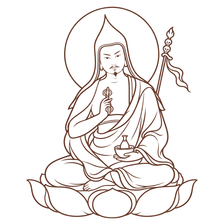
The Eight Close Sons
During a private interview in Lerab Ling, Rinpoche was asked about the eight great bodhisattvas who are also known as the ‘eight close sons’ of the Buddha.
在拉热林的一次私人会见中,有人向仁波切请问八大菩萨,他们也称为佛陀的“八大近子”。
“We know that a book by Mipham Rinpoche includes stories about the eight bodhisattvas,” Rinpoche was asked. “Has been translated? [1] And would Rinpoche summarize each section very essentially, describing the main purpose of practising each of these bodhisattvas and their specific interest or speciality?”
有人问仁波切:“我们知道,米滂仁波切有一本书,包含八大菩萨的故事。这本书译出来了吗?[1]仁波切能否极为扼要地概括各节,说明修持每一位菩萨的主要目的,以及他们各自所关注或擅长的方面?”
Rinpoche immediately replied, “What do you want to know for?”
仁波切立刻回答:“你们为什么想知道?”
“Because they are mentioned in various practices and texts,” said the students, “but when they come up, most of us don’t know who they are and what the represent.”
弟子们说:“因为各种修法与典籍都提到他们,但每当看到时,我们大多数人并不知道他们是谁,也不知道他们代表什么。”
八大近子 The Eight Close Sons
The eight close sons are:
八大近子是:
- Manjushri
- Avalokiteshvara
- Vajrapani
- Maitreya the Regent
- Akashagarbha
- Kshitigarbha
- Samantabhadra
- Nivaranavishkambhin.
- 文殊师利
- 观世音
- 金刚手
- 补处弥勒
- 虚空藏
- 地藏
- 普贤
- 除盖障。
一、文殊师利:“妙音” 1. Manjushri: ‘Gentle Voice’
Wisdom is very important for all of us. If you have perfect wisdom, the moment you hear about the qualities of the ten bhumis and five paths, you will be able to actualize them in your mind. The embodiment of this wisdom is Noble Manjushri (‘Gentle Voice’).
二、观世音:“遍观者” 2. Avalokiteshvara: ‘All-seeing One’
Once you have great wisdom, it is also important that you think of others and are concerned about their welfare – this is compassion. For Buddhists, the embodiment of compassion is Lord Avalokiteshvara, the ‘All-seeing One’. However, the Hindus think of him as the creator or protector of the world.
具足大智慧之后,同样重要的是想到他人,关心他们的福祉——这就是悲心。对佛教徒而言,悲心的化身就是观世音怙主,“遍观者”。不过,印度教徒则将他视为世界的创造者或护持者。
三、金刚手:“手持金刚者” 3. Vajrapani: ‘Vajra-in-his-Hand’
All the buddhas have power and strength, without which there’s not much you can do. The embodiment of all the buddhas’ power and strength is the Lord of Secrets, Vajrapani.
一切诸佛都具有力量与威力;没有力量,能做的事就很有限。诸佛一切力量与威力的化身,就是秘密主金刚手。
四、怙主弥勒:“慈者” 4. Protector Maitreya: ‘Loving One’
We need to train our minds so that we can think that all sentient beings are our own children and love them like a mother; we therefore train in the four immeasurables. All the other qualities we develop on the path – the thirty-seven factors of enlightenment, for example – spring from our cultivation of the four immeasurables. The embodiment of this kind of love is the Protector Maitreya.
五、圣虚空藏:“虚空之藏” 5. Noble Akashagarbha: ‘Essence of the Sky’
All the sentient beings who dwell beneath the sky are held in the buddhas’ egalitarian and compassionate embrace, in just the same way the sky shelters all sentient beings without bias or partiality. The power of this unbiased compassion is embodied in the form of the Noble Akashagarbha.
居于天空之下的所有众生,都受到诸佛平等慈悲的摄持,就像天空无偏无私地覆盖一切众生。这种无偏悲心的力量,以圣虚空藏的形相体现。
六、地藏:“大地之藏” 6. Kshitigarbha: ‘Essence of the Earth’
Similarly, the earth provides a ground which supports and holds all six classes of sentient beings, as numerous as space is vast. The essence (garbha) of the earth (kshiti), is Kshitigarbha – the ‘Essence of the Earth’, and it is thanks to this great ground that it was even possible for the six realms of sentient beings to come into being. As a result of the power of noble Kshitigarbha’s aspiration prayers and compassion, every word or gesture of compassion expressed by the one thousand and two buddhas of this ‘good kalpa’ has been focused in a single instant of Kshitigarbha’s compassion – all this is explained in the Sutra on the Tenth Mandala of Kshitigarbha[2] . And this is why Kshitigarbha’s power to benefit is so great.
七、普贤:“普遍贤善” 7. Samantabhadra: ‘Universal Excellence’
Samantabhadra embodies compassion for all beings, free from partiality (not favouring those close to you over the rest), and not mixed with attachment and aversion. Samantabhadra is like a jewel – for example, the fabled wish-fulfilling jewel – that grants you whatever you pray for, spontaneously and without effort.
普贤体现的是对一切众生的悲心,毫无偏私,不偏爱亲近者而轻忽其他众生,也不掺杂贪嗔。普贤就像一颗宝珠——例如传说中的如意宝——无论祈求什么,都能任运、无勤地赐予。
八、除盖障:“遣除障碍者” 8. Nivaranavishkambhin: ‘Remover of Obstacles’
Every mental poison and obscuration must be completely eliminated before the lotus of enlightened wisdom blossoms. The elimination of obscurations – meaning fundamental ignorance – is the most important aspect of the path, and Noble Nivaranavishkambhin is its embodiment.
在觉悟智慧的莲花绽放之前,必须彻底消除每一种烦恼毒与障垢。遣除障垢——也就是根本无明——是道上最重要的方面,圣除盖障就是它的化身。
八大近子的本性 Nature of the Eight Close Sons
These eight close sons manifest when the eight collections of consciousness are purified within basic space. Right now this consciousness is impure, but when purified within basic space, it transforms into the eight close sons; so consciousness is by nature the eight close sons.
当八识聚于法界中清净时,这八大近子便显现出来。现在,这些识是不清净的,但在法界中清净后,便转化为八大近子;因此,识的本性就是八大近子。
出处 Source
What I have told you today is what the Buddha – the Bhagavan – said about the eight close sons in many sutras. Buddha also went into great detail about the names of each of these bodhisattvas, about how just hearing their names brings blessings, and about each of the close sons’ aspiration prayers, their individual powers, and so on.
今天我告诉你们的,是佛陀——薄伽梵——在许多经典中对八大近子所作的开示。佛陀还详细讲解了每位菩萨的名字、仅仅听闻其名如何带来加持,以及每位近子的愿文、各自的力量等等。
Some termas contains offering practices to the eight close sons – Chokgyur Lingpa and Sangye Lingpa’s revelations, for example, and the Sky Dharma cycle discovered by Mingyur Dorje.
金刚乘 Vajrayana
In the language of the secret mantra Vajrayana language, “the eight close sons are the purity of the eight consciousnesses within basic space”. However, the Mahayana describes them differently.
用密咒金刚乘的语言来说,“八大近子就是八识于法界中的清净”。不过,大乘对他们的描述有所不同。
修法 Practices
Mipham Rinpoche wrote offering practices to the eight close sons and a commentary[3] . Even more profound than these texts is a prayer that appears at the beginning of the Collection of Praises section of Jamgön Kongtrül’s collected works. In this prayer, Kongtrül Rinpoche praises each of the eight close sons individually[4] – it is a wonderful practice.
When Jamyang Khyentse Wangpo travelled to Central Tibet, he visited Tashi Lhungpo in Tsang, where he met the Panchen Lama.
“Are there any really learnèd masters in Kham these days?” asked the Panchen Lama
班禅喇嘛问:“如今康区有没有真正博学的大德?”
“Based on the praise to the eight close sons that he wrote,” replied Khyentse Wangpo, “I would say yes: Jamgön Kongtrül Lodrö Tayé.”
钦哲旺波回答:“根据他所写的八大近子赞,我会说,有——蒋贡康楚·罗卓泰耶。”
Jamyang Khyentse Wangpo then showed Panchen Rinpoche the prayer. He was so amazed that he immediately folded his hands and said, “The ocean of his qualities is really beyond imagining”.
蒋扬钦哲旺波随后把这篇祈请文呈给班禅仁波切。班禅仁波切惊叹不已,立刻合掌说:“他的功德之海,实在不可思议。”
That should do for this short presentation.
作为简要介绍,讲这些应当就够了。
Translated by Gyurmé Avertin
Edited by Janine Schulz
英译:久美·阿韦尔坦
英文编辑:雅尼娜·舒尔茨
原注 Notes
出处与版本
原刊:ALL-OTR · The Eight Close Sons。讲授:12th May 2009;Lerab Ling, France。原刊发布日期:2017-08-28。